

Comptroller Sets Hearings on Software, Streaming and Manufacturing Tax Rules
The comptroller's office will hear testimony Dec. 2 and 3 on rules that would end sales tax on cloud services and streaming, restore a compressor exemption and redefine hotel project rebates.

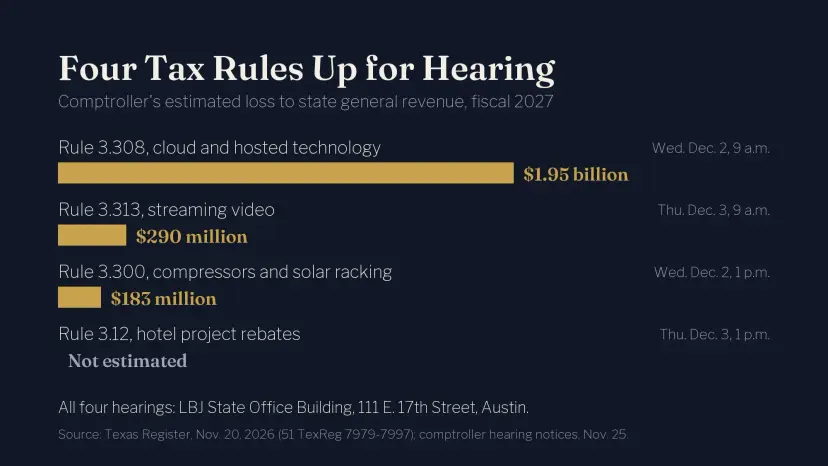

The Texas Comptroller’s office will hold public hearings Wednesday and Thursday in Austin on four proposed tax rules, including changes its own estimates say would cut state general revenue by more than $2.4 billion in the 2027 fiscal year. The rules would end sales tax on cloud computing and other hosted technology, end it on streaming video, restore an exemption for oil and gas compressors and define which businesses can share state tax rebates with hotel projects.
Interested parties requested the hearings under the Texas Administrative Procedure Act, according to the comptroller’s office. All four will take place on the first floor of the LBJ State Office Building at 111 E. 17th Street. Rule 3.308, on computer hardware, programs and services, is set for 9 a.m. Wednesday, Dec. 2, and Rule 3.300, on manufacturing, for 1 p.m. that day. Rule 3.313, on cable television service, is set for 9 a.m. Thursday, Dec. 3, and Rule 3.12, on hotel projects, for 1 p.m. Witnesses register in the half hour before each hearing, are heard first come, first served, get 10 minutes each and must submit their testimony in writing before speaking.
Comptroller Don Huffines proposed the computer rule last week, as the Partisan reported. It would define a data processing service as one in which the provider takes data from the customer and returns it in an organized, usable form, and it would place cloud computing, artificial intelligence and internet hosting in a new untaxed category of hosted technology services. The agency estimates the change would reduce general revenue by $1.95 billion in fiscal 2027, rising to $4.29 billion in fiscal 2032, with local governments losing $507 million in the first year.
The cable rule would treat video delivered over the internet as outside the tax on cable television service, unless a cable provider delivers it through its own cable system. According to the proposal published in the Texas Register on Nov. 20, the agency’s 2014 policy of taxing streaming “misinterprets” the statute, which dates to 1984. The proposal adds: “Administrative convenience is not a basis for reading a taxing statute more broadly than its words support.” The estimated cost is $290 million in state general revenue in fiscal 2027 and $84 million to local governments.
The manufacturing rule would reinstate the agency’s earlier treatment of compressors that raise natural gas to the pressure needed for processing or for entry into a sales line, and it would exempt racking and tracker systems at solar generating plants. The proposal says agency staff in recent years pushed taxpayers with compressor audits or refund claims into settlements that taxed a share of each compressor, on the theory that compressors also served a transportation function. The current comptroller “finds this theory groundless,” the proposal says. The agency puts the cost at $183 million in state general revenue in fiscal 2027, and $53 million to local governments.
The hotel rule would define when a restaurant, bar or shop is “connected to” a qualified hotel or convention center, which determines whether its state sales tax can be rebated to the project. Sixteen active projects received $23.3 million in such rebates in 2026. The agency says its proposed definition is broader than the fiscal note for the 2019 law anticipated and could cost the state hundreds of millions of dollars a year, and says the total cannot be estimated. One project that relied on a 2023 private letter ruling would receive relief, with rebates expected to exceed $70 million a year after 2027.
Comments on all four proposals are due 30 days after their Nov. 20 publication. The Legislature passed each of the statutes these rules interpret, and every exemption and definition at issue will be argued in a state office building in Austin, before Texas officials, by any Texan who signs in during the half hour before the hearing starts. Billions of dollars in Texas revenue depend on how four rules read the Tax Code, and the people who pay that tax can testify next week and tell the state, in person, how they think it should read.
See more of the Partisan in Google’s Top Stories.Add as a Preferred Source on Google
Read Next
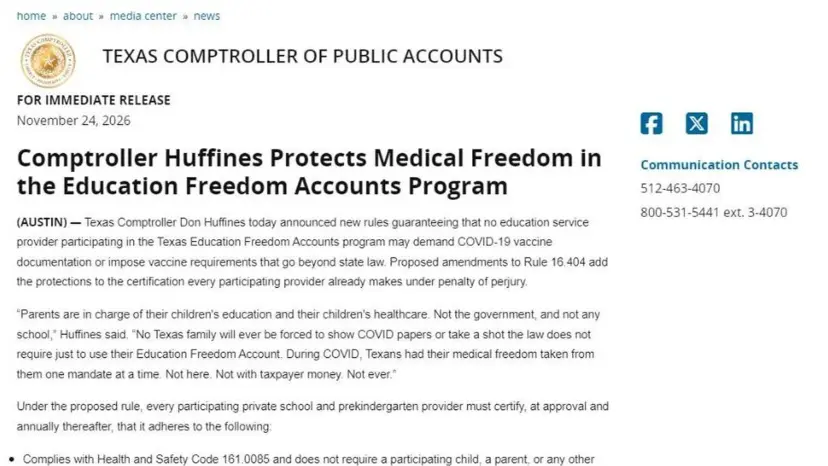
Huffines Proposes Rule Barring COVID Vaccine Demands by Education Freedom Account Schools
Proposed amendments to Rule 16.404 would add the state's COVID-19 vaccine documentation ban and school immunization exemptions to the certification providers sign under penalty of perjury.