

Feds Swore 'No Cyberattack.' Then Their Story Kept Changing.
DHS ruled out a cyberattack within hours of the FAA ground stop, then called sabotage possible. The FBI warned of AI break-ins that day, the Pentagon is readying bases to run 90 days alone, and Britain told households to stock up.

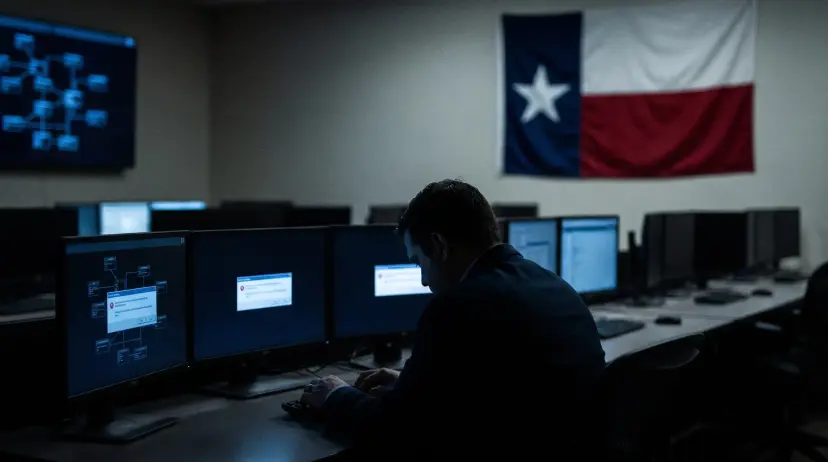

On the night of Friday, November 13, hours after the Federal Aviation Administration stopped every departure in the United States, Homeland Security Secretary Markwayne Mullin gave reporters an answer. “There is actually no cyberattack. We’re still working through that process,” he said, according to CBS News. That same day, the FBI issued a warning that criminals and state-aligned hackers were using a freely available artificial intelligence tool to “automate multiple phases of cyber intrusions at machine speed.”
Washington had moved fast to reach that conclusion. When the trouble began on Friday afternoon, the White House Situation Room went into action, Fortune reported, and the FBI, the Director of National Intelligence, the Defense Department, the National Security Agency and the Cybersecurity and Infrastructure Security Agency compared notes on a call. According to Transportation Secretary Sean Duffy, none of them saw the chatter or “footprints” that usually come with an attack. Mullin had already spoken. “There was no indication as of yet that this was a nefarious attack against us. It is just a telecommunication outage as of right now,” he told NPR. His department’s own summary of the day quoted him more firmly: “We have seen zero evidence that this is a cyberattack or an SI attack,” using the government’s shorthand for super intelligence.
The explanation for the outage changed several times over the next three days. Mullin said at the Friday briefing that new security patches loaded onto the old system appeared to “overwhelm” its routers. Senior government sources told CBS that the trouble was limited to Cisco routers built between 2001 and 2006, and also that they were “receiving conflicting information about the cause of the issue.” Duffy blamed overloaded routers, and on Sunday he told Fox News, “We think it was the installation or the router that was the bad actor.” The FAA later pointed to a switch from copper wire to fiber-optic cable at a communications node in Arkansas, Fortune reported. In its written account, the FAA said data flooded its network “at a rate of 1,000 connection attempts every 4 to 5 seconds,” that 17 of its 22 regional air traffic control centers became unstable, and that the flood may have started at one of two places: a radio site in El Dorado, Arkansas, or a radar site in Amarillo.
Mullin’s certainty moved as well. On Fox News’ Sunday Briefing, host Peter Doocy asked whether a hacker could have flooded the Arkansas routers with data. “I don’t believe in coincidences until I’m proven wrong. And right now, I’m being proved wrong,” Mullin said, as quoted by the Daily Beast. He asked himself whether sabotage was a possibility and answered: “Possibly.” Then he put a number on it, saying the failure was, “with 98 percent certainty,” the fault of “a 50-year-old system.” Doocy pressed him. Microsoft’s email and calendar services had gone down the day before the ground stop, and, as Doocy noted, Mullin had said on Friday night that the two failures were unrelated. “But you get why so many people watching this think that something big is happening here, right?” Doocy asked. Microsoft has blamed its outage on “an issue during an earlier network capacity upgrade,” and said it had no indication the two were connected. Duffy left the question open: “But we’re open. If we see something else, we’re going to continue to investigate.” The FAA’s written answer is narrower than either secretary’s. “Based on all available evidence, we have no indication that this was a cyberattack or an outside nefarious actor,” the agency said.
The FBI warning described a different picture. Its alert said “a variety of malicious cyber actors” had turned a tool called ARTEX, posted openly in July, against financial firms, government offices, energy companies and health care providers since at least August, with “some intrusions progressing from initial targeting to privileged access in under three hours.” The tool hands the work to AI agents and lets attackers with little skill run complex campaigns against many targets at once. The bureau said Chinese AI models were the most common engines powering it, with the DeepSeek family dominating because of its low cost and “lack of observable guardrails.” Its developer pulled ARTEX from public view in October, but copies and a paid version still circulate, and researchers counted more than 1,600 of its control consoles exposed on the internet in early November. In one campaign cited by the FBI, attackers using it took personal information on about 67,000 people from South Korean financial institutions. The FBI’s Dallas field office posted the warning and asked businesses to report break-ins.
The best-documented attack began with law firms. On October 13 and 14, the security company Huntress saw attackers guessing passwords against four of them, The Record reported, and a stolen credential for a backup service run by the software company ConnectWise was used to reach customers’ Microsoft 365 accounts. Microsoft says a China-aligned group it tracks as Storm-0940 used ARTEX in the campaign to try to sign in to more than 2,250 customer accounts. Huntress counted unauthorized sign-ins at 162 of them. ConnectWise told The Record there was “no indication” that backup data was taken. A second China-linked group, which CrowdStrike calls Vapor Panda, used the same tool against more than 200 organizations in 14 countries starting October 17 and broke into at least nine, BleepingComputer reported. Its targets included telecommunications providers and drug companies in the United States.
All of this landed in a month the industry had already given a name. By October 23, CNBC reported, security teams around the world were racing to patch flaws in PHP, a programming language that by some estimates runs nearly 70 percent of websites, in a moment “some have dubbed” Black October. “In the last 2 days there have been several dozen cyber attacks which, in isolation, would each have been the worst to happen in an entire calendar year,” John Milinovich, a product director at the software company Figma, wrote at the time. The federal Cybersecurity and Infrastructure Security Agency added 36 flaws that attackers were already exploiting to its catalog that month, after 43 in September, as the Texian Partisan reported Monday. Fortune counted the Federal Election Commission, Sony, John Deere and Oracle Health among the targets.

The FEC’s case shows how far a federal statement can sit from what officials know. A week before the midterm elections, when campaigns could not file the spending reports the law requires of them, the commission told the public that “at this time, the FEC’s electronic filing system is currently offline and our IT staff are actively working to restore service.” An FEC filing officer told several campaign committees something else, in an email seen by Reuters: “We have a bad actor attempting to breach FEC systems.” The commission declined further comment, CISA referred questions back to the FEC, and the FBI did not return messages. “I’ve never seen this in 26 years,” Steven Mele, a campaign finance compliance consultant, told Reuters. “The result is there will be less disclosure on the elections.”
While officials told the public there was nothing to see, the Defense Department was preparing its own bases for the worst. In a September 30 address, Defense Secretary Pete Hegseth announced a program called FORTRESS to make every major military installation produce its own power. By late October, Fox News reported from internal planning documents, the goal had grown to running each major base in the continental United States on its own for at least 90 days, covering water and fuel supplies as well as power. “Power is combat now,” Pentagon spokesman Sean Parnell said. The Army has already announced up to $2.2 billion in awards to build nuclear microreactors at five bases, Fort Hood among them, Fortune reported. The Pentagon has not named a threat. In 2024, though, CISA, the NSA and the FBI warned jointly that Chinese state hackers had broken into the networks of U.S. water and energy organizations, among others, and were potentially positioning themselves to disrupt them in a future conflict.
Households have received no such plan. The federal preparedness site, Ready.gov, tells Americans that “after an emergency, you may need to survive on your own for several days.”
Other governments have spoken more directly to their people. On October 22, Britain’s Defence Secretary, Wes Streeting, asked households to keep three days of food and water on hand, after 32 British government services were taken offline over the PHP flaw, LBC reported. He named the reason. “Are they prepared for increasingly sophisticated cyber attacks on our businesses?” he said. “How would we cope if the payment systems at the local supermarket went down?” Asked whether that would set off panic buying, he said the government wanted people “alert but not alarmed,” and that other European countries “are way ahead of us on some of this stuff.” The British campaign’s website lists cyberattacks among the emergencies households should prepare for. On November 3, the European Commission issued guidelines built around “72-hour self-sufficiency” and emergency grab bags. “When disaster strikes, the first hours can make all the difference,” Commissioner Hadja Lahbib said.
Japan went further. On November 6, after a wave of data breaches at major companies and government agencies, Prime Minister Sanae Takaichi announced a 10 billion yen, or $63 million, emergency cybersecurity package, including rescue teams for companies under attack and a team of experts using AI against hackers. “At this very moment, cases of unauthorized access and data breaches are occurring, causing a major impact on daily lives of the people and corporate activities,” she said, according to the Associated Press. At the United Nations in September, Secretary-General Antonio Guterres told world leaders that the risks of artificial intelligence now include its use to facilitate cyberattacks, the Washington Post reported.
Another federal system went down this week. On Tuesday, six people told CNN that the National Security Agency’s classified internal network was down. CNN’s sources said there was no evidence of a cyberattack. The NSA has not commented publicly.
Texans have felt each of these failures. Departures stopped at DFW and Love Field on Friday, and one of the two sites the FAA named as a possible starting point for the flood was in Amarillo. On Monday, a Chase ATM in Irving showed a “not working” screen during the bank’s own outage. The state has been building its own defense. The Texas Cyber Command, created by the Legislature in 2025 and led by retired Vice Adm. Timothy White, is due to take over the state’s cybersecurity work from the Department of Information Resources by December 31. It has already warned Texas water utilities, through a state information-sharing network, about attackers who disrupted water-plant controls in other states. On Tuesday it announced that 63 companies had volunteered to help secure Texas water and wastewater utilities at no cost to them. “Together, we are protecting the water systems that 31 million Texans depend on,” White said. The state has more than 7,400 public water systems.
The Texas Nationalist Movement argues that this is where the question of trust leads. On its website, the movement says that Texas security functions today “plug into a federal apparatus that Texans neither control nor fully see.” In two days the secretary of homeland security went from “no cyberattack” to “possibly.” A federal agency told the public its system was offline while its own officer told campaigns that someone was trying to break in. The Pentagon plans for its bases to last 90 days on their own, while the federal preparedness site tells families they may need to last several days. Britain told its people why it wanted them to stock up. The movement’s position is that people who live with the consequences of a failure are owed a government that tells them what it knows, and that Texans will have one when the government responsible for their water and their power answers to them.
See more of the Partisan in Google’s Top Stories.Add as a Preferred Source on Google
Read Next
Federal Debt Doubles in a Decade to $40.2 Trillion, Auditors Find
GAO's audit of the Treasury's debt records puts the federal debt at $40.2 trillion, up 105 percent in ten years, with interest on publicly held debt near $1.1 trillion. Texans' share of that interest...