Organic Law of 1835 Gave Texas a Government Before Independence
On November 13, 1835, the Consultation adopted the Organic Law, a 21-article plan that gave Texas a governor, a council, courts and a land policy, and set the March 1 meeting at Washington where Texans declared independence.
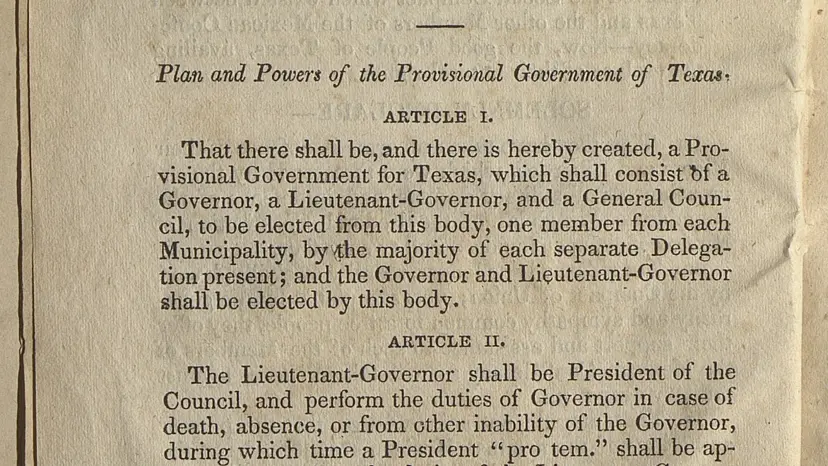

On November 13, 1835, 191 years ago Friday, the delegates of the Consultation at San Felipe de Austin adopted a plan of government for Texas. They called it the “Plan and Powers of the Provisional Government of Texas,” and the Handbook of Texas calls it the Organic Law. It ran 21 articles. Six days earlier the same body had declared that Santa Anna had dissolved the compact binding Texas to Mexico. The Organic Law was its answer to the next question: who would govern Texas now?
The first article created a governor, a lieutenant governor and a General Council made up of one member from each municipality, chosen by that municipality’s own delegation. The Consultation elected the governor itself. Henry Smith won the office over Stephen F. Austin, 30 votes to 22, according to the Handbook, and James W. Robinson became lieutenant governor.
The articles that followed laid out the work of a government. The governor was given “full and ample executive powers” and command of “the Army and Navy, and of all the military forces of Texas, by sea and land.” The governor and council could borrow up to a million dollars, pledging the public lands as security, and could set import and tonnage duties. They could open post offices and treat with the Indian tribes over their land claims. Each municipality got two judges, and the seventh article guaranteed that “all trials shall be by jury,” under the common law of England.
Land drew the most careful language, because the soldiers in the field feared that speculators would claim the spoils while they fought, the Handbook says. The Organic Law closed every land office in Texas for the duration of the war and ordered its records moved to safekeeping. It declared the grants “illegally or fraudulently made” by the legislature of Coahuila and Texas void. Anyone who left Texas during the crisis to avoid taking part, without permission from the local alcalde or judge would forfeit his land, with an exception for widows and minors.
The ninth article set the form of every commission the new government issued. Each one would run “in the name of the People, free and sovereign.” The officers who carried those commissions still swore to support “the republican principles of the Constitution of Mexico of 1824.”
The plan had a flaw that showed within weeks. The governor and the council shared many of the same powers “on the assumption that they would work together,” in the Handbook’s words, and they did not. Smith wanted to proceed as though Texas were already independent. Most of the council, from the peace party, still hoped to work with Mexican liberals, and the two sides split over the proposed Matamoros expedition. Smith tried to dissolve the council. The council impeached him and recognized Robinson as head of state. By the Handbook’s account, Texas was left without working leadership through February 1836.
The Organic Law had already set the next step. Its 17th article provided that the Consultation could adjourn “to meet at the town of Washington on the first day of March next.” In December the General Council called that convention over Smith’s veto, and delegates were elected on February 1. They met at Washington-on-the-Brazos on March 1, 1836, and the next day declared Texas independent.
The provisional government lasted less than four months and spent much of that time quarreling. It still guarded the land titles and called the convention that declared independence. And every officer it commissioned served in the name of the people of Texas, “free and sovereign,” nearly four months before the convention at Washington put that sovereignty into a declaration.
See more of the Partisan in Google’s Top Stories.Add as a Preferred Source on Google
Read Next
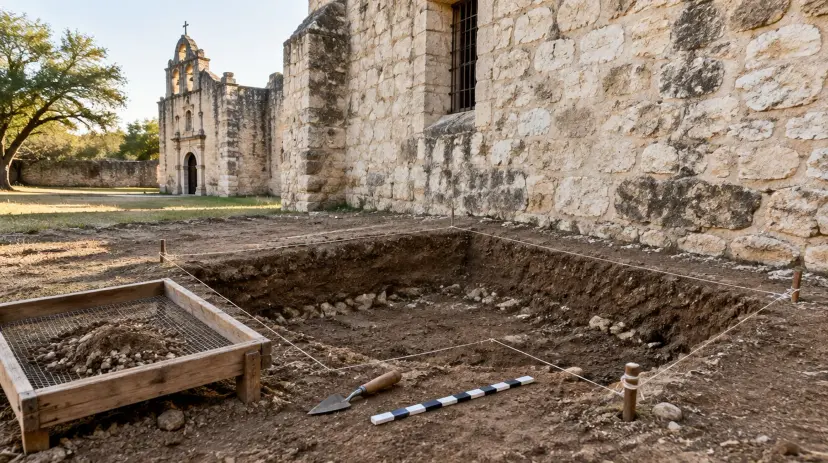
Alamo Archaeologists Unearth Four Battle-Era Cannonballs Beside the Church
An 18-month dig beside the Alamo Church recovered four solid-shot cannonballs that the Alamo's historians link to the 1836 siege and battle.