How Would an Independent Texas Defend Itself?
Texas already commands three military branches, and Washington spends tens of billions a year on defense inside the state. The Texas Nationalist Movement's plan builds on the first and settles the second by treaty.

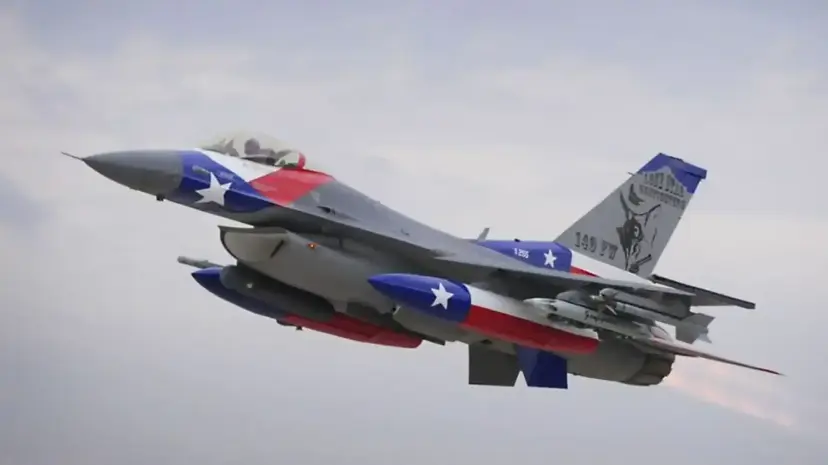

Texas already has a military. The Texas Military Department commands the Texas Army National Guard, the Texas Air National Guard and the Texas State Guard, all under an adjutant general appointed by the governor. Texas law makes the governor "the commander-in-chief of the Texas military forces, except any portion of those forces in the service of the United States."
The Texas Nationalist Movement's answer to the defense question starts with that department. Its published position is that an independent Texas would grow the forces it already commands into a national defense, and would settle the federal bases and equipment on Texas soil by treaty with the United States.
What Texas commands now
The Army Guard's largest formation is the 36th Infantry Division. The Air Guard flies combat aircraft: the 147th Attack Wing at Ellington Field in Houston operates MQ-9 Reapers and F-16s, according to the Texas Comptroller. Both Guard components are dual status. They answer to the governor in ordinary times, the President can call them into federal service, and federal law says "All military property issued by the United States to the National Guard remains the property of the United States." The movement calls the call-up power the one string Washington still holds on the Texas Guard, and independence is the step that cuts it.
The State Guard already has no such string. The federal statute that lets states keep their own defense forces says such a force "may not be called, ordered, or drafted into the armed forces." It is organized into army regiments, air wings, maritime regiments and medical battalions, and it answers to the governor alone. The movement holds that after independence every Texas force would stand where the State Guard stands today.
What Washington spends and stations in Texas
The movement's 2026 report Can Texas Make It puts federal defense spending in Texas at $47 billion to $72 billion a year. The Department of Defense's Office of Local Defense Community Cooperation counted $71.6 billion in fiscal 2023, the most of any state, and $47.4 billion in fiscal 2024, third among the states. Its fiscal 2023 count of defense personnel in Texas was 211,504, active duty, Guard, Reserve and civilian together. Lockheed Martin alone held $38.0 billion in Texas defense contracts that year, most of it the F-35 line at Air Force Plant 4 in Fort Worth.
The installations are some of the largest Washington has: Fort Hood, Fort Bliss, Joint Base San Antonio, Naval Air Station Corpus Christi, Dyess Air Force Base and the training wings at Sheppard and Laughlin.
What a Texas defense would cost
The report states that "An independent Texas would not try to copy Washington's roughly one-trillion-dollar global-posture budget." Texas would defend Texas, and the report benchmarks it to capable middle powers. Australia spent $35.3 billion on its entire military in 2025, by the Stockholm International Peace Research Institute's count, and Canada $37.5 billion. Both figures sit below the $47.4 billion Washington spent in Texas in its down year.

The movement's FAQ names what that money would defend against. The threat of a combined invasion is next to non-existent. The real ones are cartel violence spilling over the border with Mexico and terrorists using that same border to reach civilian targets inside Texas. Beyond its own security, an independent Texas would back allies where their aims match its own.
The bases and the equipment
Daniel Miller wrote in TEXIT in 2018 that it "is, therefore, highly probable that Texas would enter into a mutual defense pact with the United States that includes joint use and operation of existing military bases." The movement's FAQ adds the other branch of that sentence, full transfer of the bases to the Texas Military Department, and a transition period in which forces operate under joint command until Texas forces reach full readiness.
The treaty the movement describes has a short list of terms. Texas would pledge an agreed share of its economy to defense, as NATO members do. Both sides would guarantee tariff-free access to each other's defense manufacturers, which matters to Washington because the F-35 is built in Fort Worth. A status-of-forces agreement, the kind the United States already signs with every NATO host, would govern jurisdiction over troops. And the pact would cover commonly agreed defense concerns, not every war Washington enters.
Equipment goes to the same table. The precedent the movement points to is Czechoslovakia. Its constitutional act dividing federal property, Act No. 541/1992, sent buildings and land to the republic they stood in and split most movable property two to one, the ratio of the Czech and Slovak populations. A 1983 United Nations convention on state succession states the same rules and divides movable property "in an equitable proportion." It never entered into force, and negotiators have followed it anyway.
The strongest objection
The serious objection concerns the months between a vote and a treaty. Federal law, including 10 U.S.C. 12406 and the Insurrection Act, lets the President call the Guard into federal service, and in Perpich v. Department of Defense in 1990 the Supreme Court held that a governor cannot block federal orders sending Guard members abroad for training. A critic adds that Texas has no navy and no large cargo planes to move troops and equipment over long distances.
The movement treats the call-up authority as a real contingency to plan and negotiate around. Its answer rests on the people who would carry out such an order. They are Texans, and under Article 1, Section 22 of the Texas Constitution a Texan who took up arms against the lawfully elected government of Texas would commit treason. On the sea, the movement plans a coast guard built from the State Guard's maritime regiments rather than a blue-water fleet. In the air, it points to the Air Guard wings already flying and to NORAD, the binational command through which even Washington shares the defense of North American airspace.
Nuclear weapons, the FAQ says, would be a decision for the government Texans elect, and Texas security does not depend on them.
Canada has defended North American skies jointly with the United States since 1958, on a military budget smaller than what Washington spent inside Texas in fiscal 2024.
See more of the Partisan in Google’s Top Stories.Add as a Preferred Source on Google
Read Next

What Happens to Social Security If Texas Becomes Independent
Nearly five million Texans draw Social Security. The Texas Nationalist Movement's position is that every Texan who paid in and draws benefits keeps them, and Washington already pays its citizens abroad.