

Texans Charged a Mexican Supply Train 191 Years Ago and Captured Grass
On November 26, 1835, Texan volunteers besieging San Antonio charged a Mexican pack train they hoped carried the garrison's pay. The 40 animals were carrying grass. Thirteen days later the town was in Texan hands.


On the morning of November 26, 1835, the scout Erastus “Deaf” Smith rode into the Texan camp outside San Antonio with word that Mexican cavalry and a train of pack animals were approaching the town. By evening the volunteers had driven the Mexican troops back behind their defenses and taken 40 of the animals. When they opened the packs, the Handbook of Texas records, they found the animals “carried only grass to feed army animals.” Texans have called the skirmish the Grass Fight ever since.
The siege of Bexar was in its second month. Gen. Martín Perfecto de Cos held San Antonio with a Mexican army that had fortified the town plazas and the Alamo, the former mission across the river. The Texan volunteers, who had driven off Mexican troops at Gonzales on October 2, had advanced on San Antonio and camped along the river above and below the town. Their numbers rose and fell as men went home for winter clothes and new companies arrived from East Texas and beyond, among them a company of Mexican Texans under Juan N. Seguín. Stephen F. Austin had commanded them until shortly before the fight, when he left to represent Texas in the United States. The men elected Col. Edward Burleson to replace him.
Both armies were cold and short of supplies. Col. Domingo de Ugartechea had ridden out of San Antonio earlier in the month to bring reinforcements up from below the Rio Grande, and the Texans had been watching for his return. When Smith reported the column, the soldiers wondered whether the pack animals might be carrying pay for the Mexican garrison. The Texas State Library and Archives Commission describes “high hopes” that the packs held silver coins.
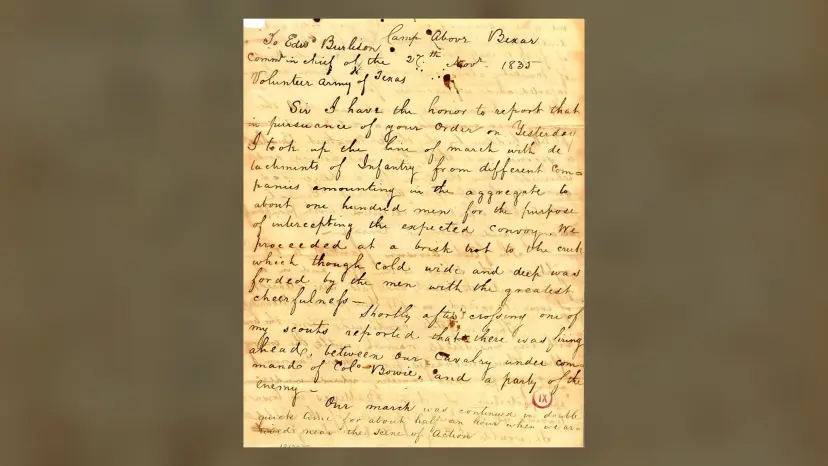
Burleson sent James Bowie ahead with about 40 cavalry to slow the column, and William H. Jack followed with about 100 infantry to seize the train. Jack’s report to Burleson, written the next day and kept in the State Library’s archives, describes the march. The men reached a creek “which though cold wide and deep was forded by the men with the greatest cheerfulness,” then went forward at double time toward the sound of Bowie’s fight. Near the scene they were met from 40 to 60 yards off by “a tremendous discharge of musketry” from Mexican soldiers hidden in a ditch behind thick mesquite.
The fighting ran along ravines near Alazán Creek, west of town. Cos sent about 50 infantry and a cannon out to support the cavalry. The Texan infantry fought its way out of a crossfire and charged. The Mexican troops counterattacked four times, according to the Handbook, and pulled back into San Antonio when more Texans arrived under James Swisher. Jack wrote that his men “did what Texas expected of him” and that “the only cause of complaint arose from their impetuosity.” He singled out Burleson’s father, Capt. James Burleson, an older man who had run from one end of the field to the other urging the line forward.
The Handbook counts four Texans wounded, and three Mexican soldiers killed and 14 wounded, most of them cavalry. Jack reported one infantryman missing and three “very slightly wounded.” The prize was the grass.
The siege nearly fell apart in the days after. With winter coming and supplies low, Burleson considered pulling back to Goliad. Instead, on December 5, Benjamin R. Milam and Francis W. Johnson led some 300 volunteers into the town. They fought house to house for four days, and Milam was killed by a sharpshooter on December 7. Cos asked for terms on the morning of December 9 and was allowed to march his men south. With his withdrawal, the Handbook says, San Antonio “and all of Texas” were left under the Texans’ control.
The army that fought the Grass Fight answered to no recognized government. Its men chose their own commander after Austin left, and a scout’s report was enough to send 100 of them across a cold creek after a payroll that turned out to be fodder. Thirteen days later the same volunteers held San Antonio. The convention at Washington-on-the-Brazos would not declare independence until March 2, 1836, and by then the men who had forded that creek had already put the town in Texan hands.
See more of the Partisan in Google’s Top Stories.Add as a Preferred Source on Google
Read Next
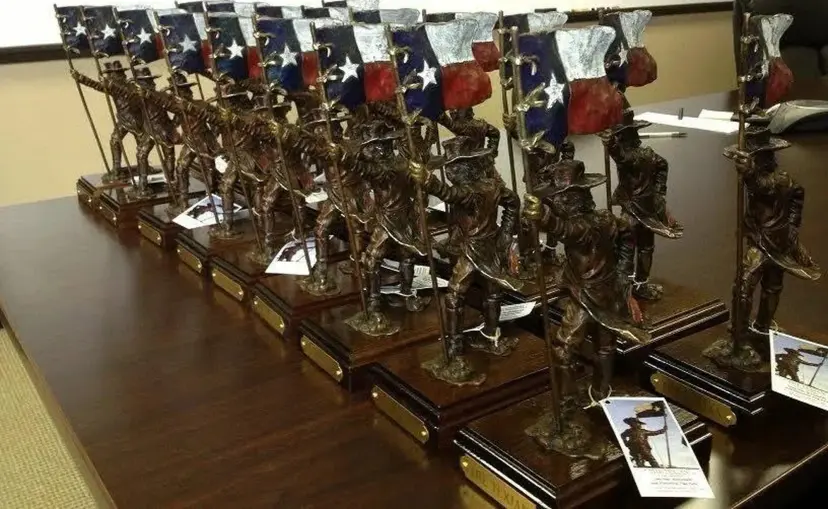
Craig Campobella, the Sculptor Who Cast the Texas Revolution in Bronze, Dies
Craig Campobella, the Conroe sculptor of the Texian, the First Stand bronzes at Anahuac and a Battle of Gonzales statue, died Thursday. TNM's miniature Texians came from his hand.