Alamo Archaeologists Unearth Four Battle-Era Cannonballs Beside the Church
An 18-month dig beside the Alamo Church recovered four solid-shot cannonballs that the Alamo's historians link to the 1836 siege and battle.
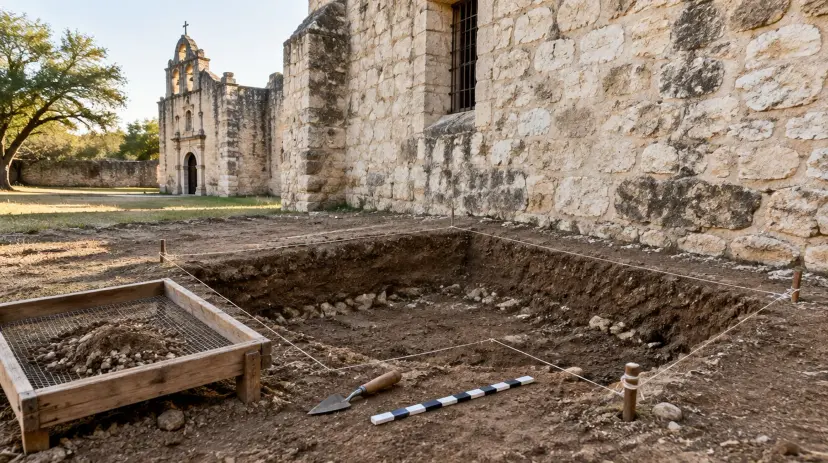

Archaeologists at the Alamo have recovered four solid-shot cannonballs from the ground outside the northeast corner of the Alamo Church, and the Alamo’s historians link all four to the 13-day siege and battle of 1836. Alamo Trust, which runs the site, announced the finds Thursday as an 18-month excavation around the church came to an end.
The first was found on March 5, 2026, the eve of the battle’s 190th anniversary. It is bronze, 2.97 inches across, and fits a 4-pounder cannon. The second, found in June, is iron, 3.28 inches across, and fits a 6-pounder. The third is bronze, 1.8 inches across, and fits a 1-pounder. The fourth is bronze, 3.26 inches across, and fits a 6-pounder. All four lay at about the same depth, two and a half to three feet below the surface.
“Having a piece of history and holding it in your hand, when the last person who touched this possibly died during the Battle, that carries a lot of emotional weight to it,” said Dr. Tiffany Lindley, the Alamo’s director of archaeology.
Why the finds are rare
The Alamo’s historians tied the cannonballs to the siege by the soil layers they lay in, the types of shot, and the sizes of the cannon known to have been at the battle. Kolby Lanham, the Alamo’s historian and director of research, said finding one at all is unusual. “Cannonballs were picked up after battles. They were re-used. That metal was semi-precious,” he told the Alamo’s podcast. “So to find one is very rare.”
Who fired them is harder to say. Three are bronze, a metal typically used by the Mexican army, and one is iron, which the Alamo associates with the Texan side. The Alamo changed hands twice during the Texas Revolution, in December 1835 and in March 1836, and Lanham said the two armies ended up using each other’s equipment. His guess, based on battle maps and the artillery positions on the north side of the battlefield, is that the bronze balls were more likely made in Mexico and fired by the Mexican army at the church.
The guns of 1836
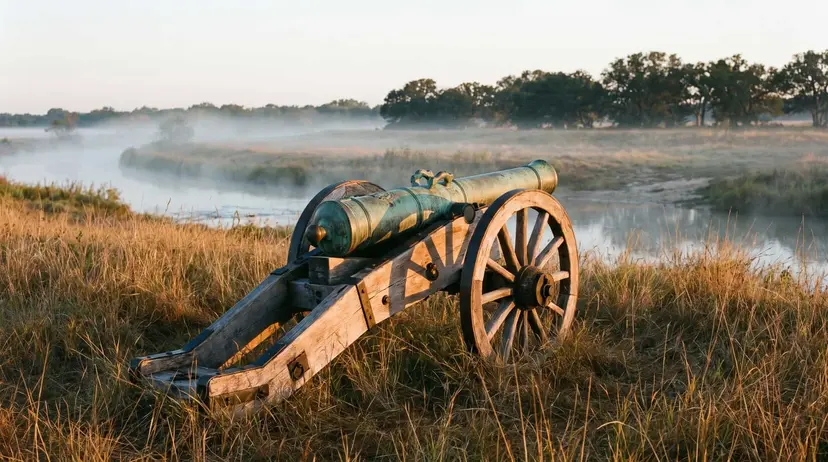
The garrison at Bexar had some 21 artillery pieces of various caliber, according to the Handbook of Texas. When Santa Anna demanded the Alamo’s surrender, William Barret Travis answered with a cannonball. Mexican artillery then went to work on the walls, and the defenders reported a continual bombardment. The final assault came around 5 a.m. on March 6.
What the dig found
The excavation began in March 2025, ahead of preservation work on the church. Lindley estimates it turned up 500,000 to 750,000 artifacts, including a tea kettle, forks, spoons and bottles. The team is still processing them.
The church is one of two structures still standing from the battle. The ground beside it held four rounds from the siege for 190 years.
See more of the Partisan in Google’s Top Stories.Add as a Preferred Source on Google
Read Next
Gonzales Celebrates Come and Take It Weekend With Battle Reenactment
Gonzales holds its Come and Take It Celebration October 2 through 4, with the Battle of Gonzales Reenactment Saturday afternoon on the 191st anniversary weekend of the 1835 standoff.