

Chase Outage and FAA Ground Stop Show How Little Texas Controls
A software bug at JPMorgan Chase stalled banking in Texas three days after a federal network failure stopped every departure. Texans depend on systems run by a few companies and agencies, and have no say in how they are built or repaired.

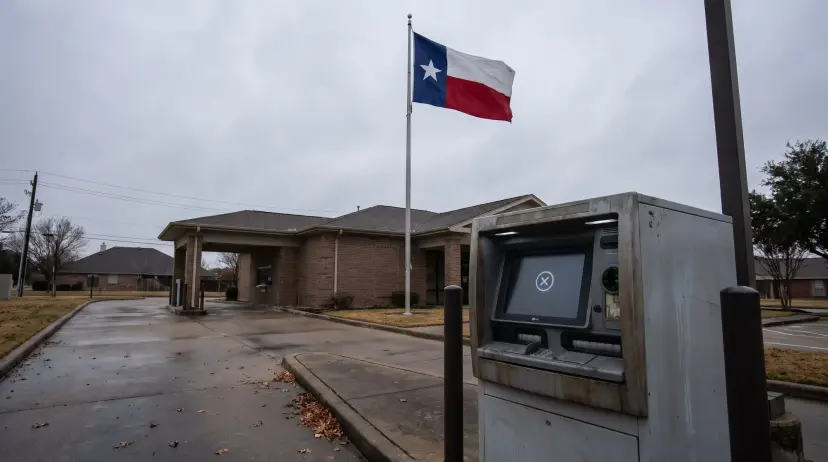

A software failure inside JPMorgan Chase stalled online banking and in-branch transactions on Monday, both for Chase customers and for customers of other banks trying to move money to them, three days after a failure in the federal air traffic network stopped every departure in the United States. An Associated Press photograph showed a Chase ATM in Irving with a “not working” screen. In Dallas, a customer told CBS News that a teller turned away the man ahead of him because the “system was down.” By 2 p.m. Eastern, nearly 4,800 people had reported trouble with Chase to the tracking site Downdetector, more than at any other bank.
Chase said the problem was its own. The bank “has experienced a temporary issue related to a software bug in an on-premise hardware system,” spokesman Joe Evangelisti told the AP, and other banks were slowed “only to the extent that they were a party to a transaction with us.” It was not a cyberattack, he said. The company that runs Zelle said the trouble at the banks “may be delaying Zelle payments for some of their customers.”
On Friday the failure was in the federal government’s own network. At about 2:30 p.m. Central on November 13, the Federal Aviation Administration halted departures across the country after, in its words, its “legacy equipment became unstable when data began flooding the FAA FTI network, at a rate of 1,000 connection attempts every 4 to 5 seconds.” Seventeen of its 22 regional air traffic control centers lost stability. The agency’s first look pointed to two places the flood may have started, a radar site in Amarillo and a radio site in El Dorado, Arkansas, where its contractor, L3Harris, had been installing a new router. About 3,500 planes already in the air landed safely, and operators canceled about 12,462 flights that day, though the FAA said not every cancellation came from the ground stop. The same contractor’s backup systems had failed in Dallas fourteen months earlier, when a data line serving the facility that guides planes into Love Field and DFW went down and stopped flights at both airports for about five hours. American Airlines canceled more than 530 flights that day, CBS Texas reported. The day before Friday’s ground stop, an outage at Microsoft had knocked out Outlook and Teams for hours.
Failures like these have reached Texans for years, and almost none of them started in Texas. In January 2023, contractors working on the FAA’s system for notices to pilots deleted files by mistake, and airlines canceled more than 1,300 flights. In July 2024, a faulty update from CrowdStrike, an Austin company, crashed an estimated 8.5 million Windows computers around the world, according to Microsoft. The Texas Department of Public Safety closed every driver’s license office in the state that day, and Harris Health canceled its elective procedures. In October 2025, part of Amazon’s cloud failed for about 14 and a half hours over a timing flaw in its own software. Even the Federal Reserve has gone down. In February 2021, an “operational error” took all 14 of its payment services offline at once, including the wire system banks use to settle large transfers. “This was human error,” a Fed spokeswoman said.
October brought a different problem: software flaws that attackers were using before most owners had fixed them. The federal Cybersecurity and Infrastructure Security Agency added 36 flaws to its catalog of vulnerabilities already being exploited, after 43 in September. Through the first eight months of the year it had been adding about 25 a month. Many of October’s were in the equipment businesses and governments buy to keep intruders out. One, in Ivanti’s remote-access gateway, “allows a remote unauthenticated attacker to execute arbitrary commands.” Another, in Palo Alto Networks firewalls, could let an attacker run code “with root privileges on the firewall.” Cisco, Fortinet, BeyondTrust and Microsoft Windows all landed on the list before the month was out, and federal agencies were given three days to fix most of the flaws. Every organization running the same product had the same hole until it patched.
Washington did not cause all of them. On Monday the Fed’s own payment services reported normal operations, according to its public status page, and the card networks kept running. Most of these failures spread for the same reason: a few companies and agencies run systems that millions of people depend on. Economists at the Federal Reserve Bank of Kansas City found in 2024 that three companies, Fiserv, Jack Henry and FIS, “served more than 70 percent of banks surveyed in 2022,” and that “the core services market is highly concentrated.” The automated payments that carry paychecks and utility bills run through two operators, the Federal Reserve Banks and one private network. The Treasury Department warned in 2023 that cloud computing for banks had become “concentrated around a small number of CSPs,” so that one provider’s trouble “could affect many financial sector clients concurrently.” The federal government’s own systems are old. The Government Accountability Office reported last year that seven of the 11 federal computer systems most in need of replacement “are operating with known cybersecurity vulnerabilities.” The oldest, at the Department of Defense, is 60 years old. Texans depend on these systems and have no say in how they are built or repaired.
The one large system Texas does run shows the difference. The Electric Reliability Council of Texas serves more than 27 million customers, about 90 percent of the state’s electric load, and answers to the Public Utility Commission and the Legislature. It failed Texans in February 2021, during Winter Storm Uri, when it ordered 20,000 megawatts of rolling blackouts and more than 4.5 million Texans lost power, according to the Federal Energy Regulatory Commission. The Department of State Health Services confirmed 246 deaths tied to the storm. Texans knew whom to hold responsible, and the Legislature that answers to them passed Senate Bill 3, requiring the power system to prepare for weather emergencies, which took effect that June. Sen. Bob Hall has already prefiled Senate Bill 191 for the coming session to bar any connection that would “subject the ERCOT power region to additional federal control or jurisdiction.”

Texas has started building more of that kind of capacity. The Legislature created the Texas Cyber Command in 2025 with $135 million, a department the governor’s office called “the largest state-based cybersecurity department in America,” and it is due to take over the state’s cybersecurity work by December 31. House Bill 1056 made gold and silver legal tender in Texas this September and, starting in May 2027, lets the comptroller set up electronic systems for paying with currency backed by metal held in the state’s own bullion depository. House Bill 165, prefiled for 2027, would require the comptroller to do it. The Texas Stock Exchange began trading in July.
The Texas Nationalist Movement has spent much of the past year doing the same with its own operations, moving its member app, email list, supporter records and news site onto software it built or runs itself. “An independence movement that can be silenced by a company in California isn’t independent at all,” TNM President Daniel Miller said last December, when the movement began streaming its broadcasts on its own platform.
The movement argues that this is the work of a nation governing itself. On its website it says Texas security functions today “plug into a federal apparatus that Texans neither control nor fully see,” and that a Texas-run cyber agency would defend “the Texas grid, Texas water systems, Texas financial networks, on a Texas timeline.” It does not pretend Texas would stand alone; it says an independent Texas would share threat information with allies the way every modern country does. Its case is about who answers when something breaks. When the Texas grid failed, Texans could hold their own legislators to account, and the law changed within four months. No Texan has that power over a bank’s computer systems or a federal router in Arkansas, and the movement’s argument is that the systems Texans cannot live without should answer to the people who live with the consequences.
See more of the Partisan in Google’s Top Stories.Add as a Preferred Source on Google
Read Next
Federal Debt Doubles in a Decade to $40.2 Trillion, Auditors Find
GAO's audit of the Treasury's debt records puts the federal debt at $40.2 trillion, up 105 percent in ten years, with interest on publicly held debt near $1.1 trillion. Texans' share of that interest...