What Abbott and Hinojosa Can Do With Two Empty Senate Seats
No one can appoint replacements for Nathan Johnson and Sarah Eckhardt in the Texas Senate. Johnson's timing and two governors' choices decide when the seats are filled, and who benefits.


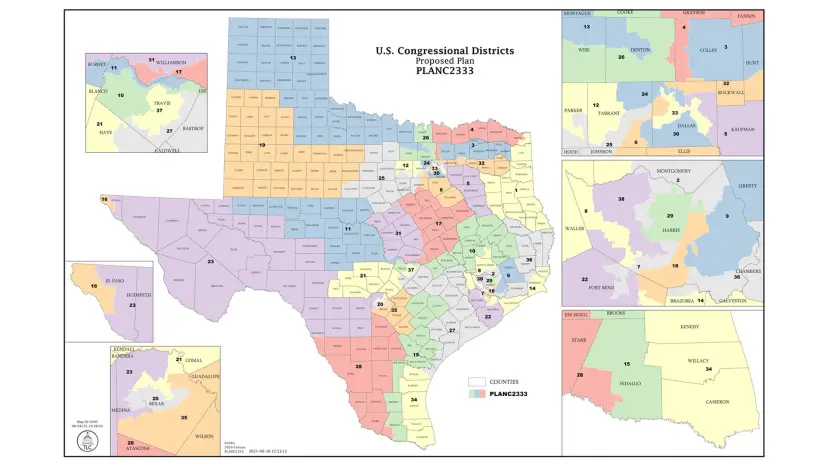
Asked when he would give up his Texas Senate seat, Attorney General-elect Nathan Johnson answered the Dallas Morning News in a one-word text: “Thinking.” He has reason to. Johnson’s Dallas seat in District 16 and Comptroller-elect Sarah Eckhardt’s Austin seat in District 14 will both open when they take their new offices in January, and both must be filled by special election, KXAN reported. Nobody in Texas can appoint a replacement for either one. The Texas Constitution exempts “members of the Legislature” from the governor’s power to fill vacancies by appointment. The Election Code says an unexpired legislative term “may be filled only by a special election.” That leaves the timing to whoever holds the power to order the election, and the power changes hands in the middle of the calendar.
Republicans will hold the Senate 19 to 12 when the 90th Legislature convenes on January 12, the Associated Press projects. Gov. Greg Abbott leaves office at noon on January 19, when Governor-elect Gina Hinojosa is sworn in. Both seats are held by Democrats who won statewide office last week.
The rules are fixed. Article 3, Section 13 of the Texas Constitution says the governor “shall issue writs of election” for a legislative vacancy, and if the governor fails to do so “within twenty days after it occurs,” the district’s returning officer may order the election instead. Section 203.013 of the Election Code sets an expedited schedule when a vacancy occurs “during the 60 days immediately prior to the date of convening any session of the legislature.” For a session opening January 12, that window opens on November 13. An expedited election falls on a Tuesday or Saturday between the 21st and the 45th day after the order, with a filing deadline the governor sets at least five days after the order. A vacancy outside the window goes to the first uniform election date at least 36 days out, which for a vacancy created this month is May 1, 2027.
Johnson’s answer is about that window. If he waits and takes the oath, the vacancy occurs on the day he qualifies for the new office, inside the window, and the latest the election can fall is early March. A resignation hands the clock to Abbott. Under Section 201.023 it creates a vacancy on the day the governor accepts it or the eighth day after he receives it, whichever is first. A letter Abbott accepted before November 13 would put the vacancy outside the window and let him set the election for May 1, with most of the session gone. A letter accepted later would start the 20-day constitutional clock and let Abbott pick an expedited date in December or January. Either way, resigning early gives a Republican governor the choice of date. Waiting gives it to Hinojosa, or at least makes it Abbott’s choice only during his last 18 days in office. Every incentive points Johnson toward waiting.
Texas has done it the fast way before. On November 14, 2014, Sen. Glenn Hegar, a Katy Republican elected comptroller ten days earlier, told Gov. Rick Perry he would resign effective December 5, the Texas Tribune reported. Perry set a special election for December 6 that afternoon, and Lois Kolkhorst won it outright with 55.7 percent of the vote before the session opened. Hegar and Perry belonged to the same party and wanted the same outcome. Nothing like that alignment exists this year.
Abbott’s choices are narrower than they look, because the Constitution’s 20-day clock limits how long a vacancy can go without an order. If Johnson’s seat opens on January 1, the writ is due by January 21. Abbott could act on the first day of the year, set the election for as early as Saturday, January 23, and choose the shortest filing window the law allows, five days. A short filing window rewards candidates who are already organized, and in all-party special elections in Democratic districts, Republicans’ realistic path is a runoff against a divided Democratic field. KXAN noted that Republicans would hold a two-thirds Senate majority if they flipped both seats. That would take Republican majorities in Austin’s District 14 and in District 16, which the Morning News calls heavily Democratic.
The likelier course, and the one the Dallas Morning News reports most political experts expect, is that Abbott does nothing and leaves the orders to Hinojosa. Doing nothing costs him nothing. He has no next session to protect, and he can leave office on January 19 without his name on the proclamation. The effect of that inaction is limited. An order Hinojosa signed on her first day would set elections between Tuesday, February 9, and Tuesday, March 2, against a window of January 23 to February 13 had Abbott ordered on New Year’s Day. The difference is about three weeks.
What three weeks buys is narrower still. Republicans hold a majority with 29 seats filled or 31. Nineteen senators cannot make a quorum on their own either way, because the Constitution requires two-thirds of each house. Governor’s appointees need “two-thirds of the Senate present” to be confirmed, so Hinojosa’s early nominees would need Republican votes no matter how many seats are filled. The vote an empty seat really moves is a veto override. The house where a vetoed bill started needs “two-thirds of the members present.” With all 31 senators present, that is 21 votes, and the 19 Republicans need two Democrats. With 29 present, it is 20, and they need one. That bar applies only to bills that started in the Senate, since the second house must muster two-thirds “of the members of that House,” and most vetoes land at the end of a session, long after the special elections are over.
Read that way, the maneuvering is less about blocking two seats than about who signs the order and how the first weeks of the session look. Hinojosa is in position to sign both orders within hours of taking office, and the date she picks will be one of the first acts of a governor who faces a Republican Senate. Until then, roughly 1.9 million Texans in two Senate districts will watch the session open without a senator, about 940,000 in each by the 2020 census count.
See more of the Partisan in Google’s Top Stories.Add as a Preferred Source on Google
Read Next
Texas Republicans Lose Their Committee Gavels as Democrats Take Congress
Ted Cruz, Jodey Arrington, Brian Babin and Roger Williams lose their committee chairs as Democrats take Congress, and James Talarico joins Cruz on the Senate seat that decides Texas's federal judges.