

Texas’s First Statewide Risk-Limiting Audit Confirms Senate Race Result
County teams pulled 1,200 randomly selected paper ballots on Nov. 19 and 20, and the state's first statewide risk-limiting audit confirmed the Senate outcome in a single round.

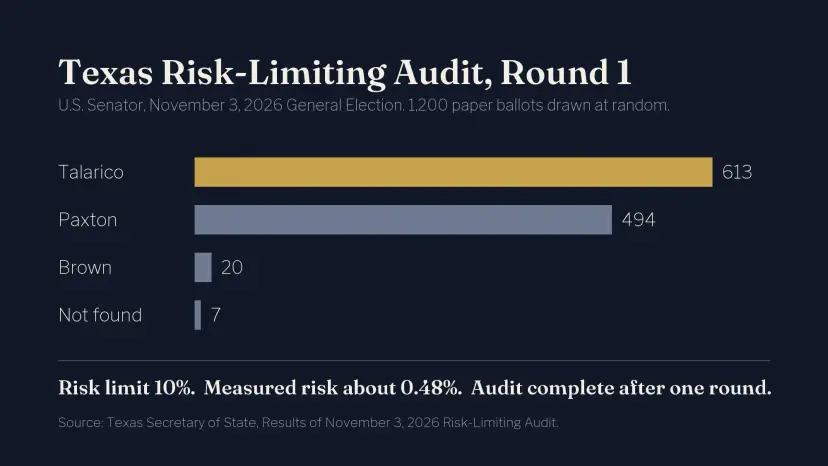

Texas’s first statewide risk-limiting audit found strong statistical evidence that the reported outcome of the Nov. 3 U.S. Senate race is correct, according to results posted by the Secretary of State’s office. County audit teams pulled 1,200 randomly selected paper ballots on Nov. 19 and 20, and one round was enough to complete the audit.
The audit checked the race won by James Talarico, who received 5,469,631 votes to Ken Paxton’s 4,264,317 in the totals the audit used. With a risk limit of 10%, the office reported a measured risk of less than 1% after the first round, “providing strong statistical evidence that the outcome for U.S. Senator is correct.” The state’s report puts the figure at about 0.48%.
Of the 1,200 sampled ballots, 613 showed a vote for Talarico, 494 for Paxton and 20 for Ted Brown. Seven could not be found, and the report shows them counted for the losing candidate. Most of the rest were ballot sheets that did not carry the Senate race, such as other pages of multi-page mail ballots.
Texas uses a ballot-polling audit. Each county sent the state a ballot manifest listing how many ballot sheets sat in each container, 10,722,383 statewide, and the office said all 254 counties submitted the information the audit required. The Secretary of State rolled dice on a livestream to set the seed for the random draw, and the same seed produces the same list of ballots every time, so anyone can rerun the selection and check it. The draw landed in 133 counties. Before opening a box, county teams checked its chain of custody, and county election officers were to keep the teams party-balanced “to the extent possible,” according to Election Advisory 2026-30, issued Nov. 4 by Director of Elections Christina Adkins.
The Legislature created the program with Senate Bill 598 in 2021, and the office ran pilots with counties in the years since. Under Chapter 127, Subchapter I of the Texas Election Code, the audit applies to any election held after Aug. 31, 2026, that includes a statewide race or measure and uses an auditable voting system. Every county must take part, whether it counts its ballots by machine or by hand. Had the first round fallen short, the state would have drawn more ballots, and after several unsuccessful rounds the Secretary of State could have ordered a full hand recount.
Every step of the audit was set by Texas law and carried out by Texas officials. The Legislature wrote the requirement, the Secretary of State’s office ran the draw, election officers in all 254 counties sent in their manifests, and county teams in 133 of them opened the boxes and reported what the paper showed. The result is a spreadsheet anyone can download and a random seed anyone can rerun. A state that can show its own voters, with paper ballots and published arithmetic, that a statewide count of nearly 10 million votes came out right already runs its own elections and can prove it.
See more of the Partisan in Google’s Top Stories.Add as a Preferred Source on Google
Read Next
SB 17 Study Finds Grades Rising and Fewer Admitted Students Enrolling
The coordinating board's first report since SB 17 took effect shows rising grades at two-year colleges and a falling share of admitted students enrolling at public universities.