

Texas Created Its Own Navy 191 Years Ago Today
On November 25, 1835, the General Council ordered four armed schooners for Texas, months before the declaration of independence. The fleet kept the coast open through the Revolution, and Galveston refused to let it be sold.

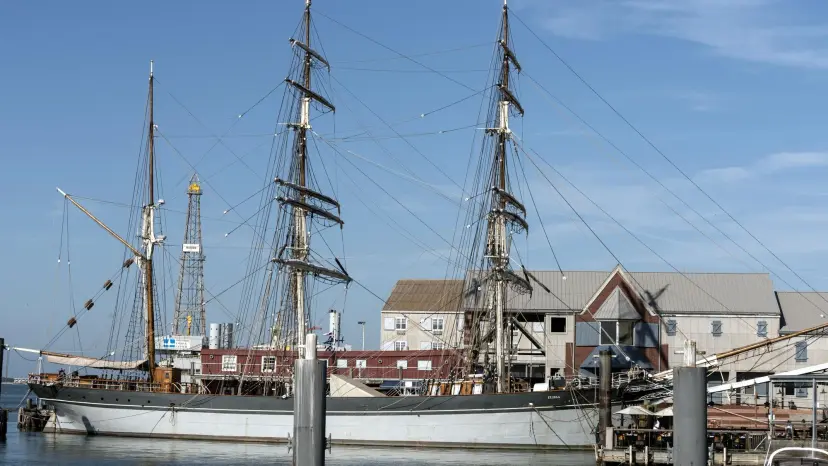

On November 25, 1835, the General Council of the provisional government of Texas, meeting at San Felipe de Austin, passed an ordinance establishing a navy. The ordinance called for “two schooners of twelve guns each, and two schooners of six guns each,” to be bought, armed and put into service “as soon as practicable,” with their commanders “under the orders and directions of the Governor and Council.” Governor Henry Smith approved it on November 27. The ships were to gather in Galveston Bay.
Texas had no declaration of independence yet. That came on March 2, 1836. It also had no money to speak of. What it had was a coast, and nearly everything the revolt needed arrived by sea. Most settlers had come by ship from New Orleans or Mobile to Galveston, Matagorda Bay or the mouth of the Brazos, according to the Handbook of Texas, and cotton, lumber and wool went back the same way. A Mexican squadron in the Gulf could cut that line.
The same day, the Council passed an ordinance granting letters of marque and reprisal, commissions that let privately owned ships make war on Mexican shipping and bring their prizes into a Texas port. A navy could not be built overnight. Texas issued six such letters in all, the Texas State Library and Archives Commission records, to the San Felipe, the William Robbins, the Terrible, the Thomas Toby, the Flash and the Ocean.
The navy itself came into being in January 1836, when Texas bought its four schooners. The William Robbins was converted and renamed the Liberty. The Independence had been a United States revenue cutter. The Invincible and the Brutus completed the fleet. In March, President David G. Burnet named Charles E. Hawkins commodore.
The fleet was small and always short of money. The Liberty was sold in New Orleans in July 1836 because Texas could not pay its repair bill. Two other ships were nearly sold in New York for the same reason until a customs collector there paid their expenses himself. Even so, the Handbook credits the first navy and the privateers with control of the sea lanes along the coast, which kept the Texas army supplied while denying supplies to Antonio López de Santa Anna’s forces on their way to San Jacinto. It calls that denial “a major factor in the Texas victory.” By the fall of 1837 all four ships were gone: the Liberty sold, the Independence captured, the Invincible destroyed after running aground off Galveston and the Brutus lost in a storm.
The Republic of Texas built a second one. Congress voted in 1837 to have six ships built in Baltimore, and between 1839 and 1840 the schooners San Jacinto, San Antonio and San Bernard, the brigs Wharton and Archer and the sloop of war Austin arrived at Galveston. Commodore Edwin Ward Moore, 29 when he was appointed, took them to sea. In 1841 Texas made an alliance with Yucatán, which agreed to pay $8,000 a month toward the fleet’s upkeep. On April 30, 1843, Moore’s ships fought a Mexican squadron that included two large steamers, one of them ironclad.
Five weeks earlier, President Sam Houston, who had opposed the cruises, had proclaimed the navy pirates and asked friendly governments to seize the ships. When Moore sailed into Galveston on July 14, 1843, the town greeted him as a hero. Houston then had the fleet put up for auction. The people of Galveston turned out for the sale and, in the Handbook’s words, “by force prevented the submission of bids.” The navy stayed with the Republic. Moore was later tried and found not guilty.

In June 1846, after annexation, the remaining ships were transferred to the United States Navy. Their officers asked to transfer with them, and United States naval officers opposed it, according to the Handbook. Three of the ships were soon declared unfit for service, and the officers’ claims were not settled until 1857.
The Handbook says the navy was largely forgotten until 1958, when Gov. Price Daniel established a Third Texas Navy during the tidelands controversy, the dispute with Washington over title to the state’s offshore lands, and the Legislature has named the third Saturday in September Texian Navy Day “in remembrance of the Texian Navy.”
The provisional government that ordered the schooners had no treasury and no ships. It decided anyway that Texas would guard its own coast, with officers answering to a Texas government. Eight years later, when the Republic’s president tried to sell the fleet, the people of Galveston kept it. The navy sailed as long as Texas governed itself, and its ships passed to another government’s navy only with annexation.
See more of the Partisan in Google’s Top Stories.Add as a Preferred Source on Google
Read Next
Stephen Fuller Austin Built Texas Self-Government Before He Fought for It
Stephen F. Austin was born November 3, 1793. Before the Texas Revolution, he gave his colonists elected local judges, a written code, an appeals court and a bound land record.