
Canada’s Supreme Court Upholds Quebec Secularism Law Shielded by Notwithstanding Clause
Canada's Supreme Court left Quebec's religious-symbols ban in place and held that courts cannot declare rights infringed once a legislature validly invokes the notwithstanding clause. It struck the face-covering rule for legislators.

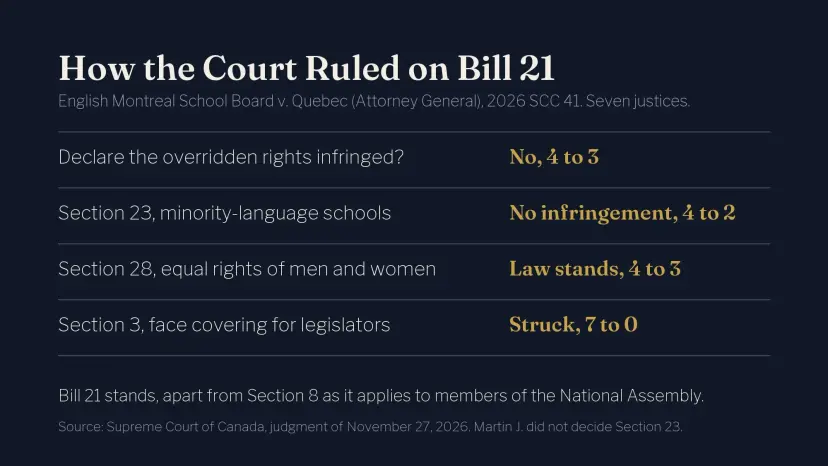

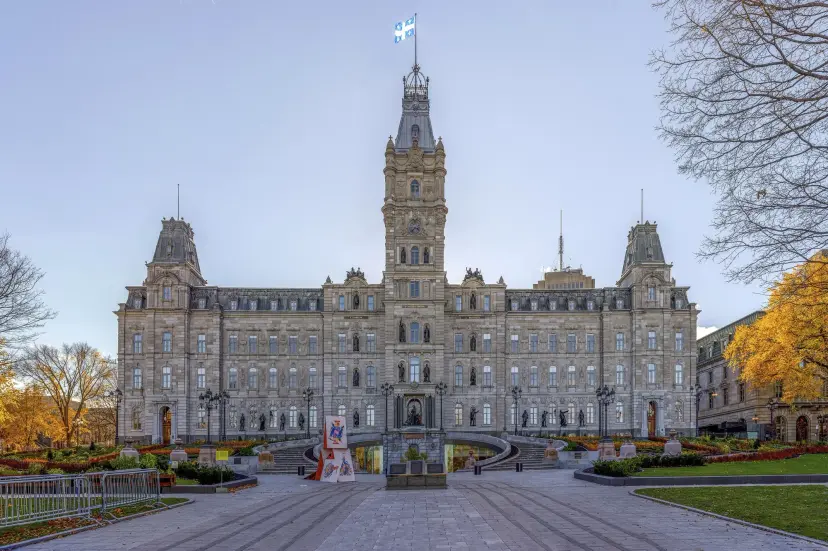
The Supreme Court of Canada on Friday upheld nearly all of Quebec’s secularism law, ruling that the province validly used the Charter’s notwithstanding clause to shield it and leaving in place its ban on religious symbols for teachers and other public officials. The court struck one piece: the law’s face-covering requirement, as it applies to members of the National Assembly.
“Bill 21 is valid and operative, apart from s. 8,” the court held in English Montreal School Board v. Quebec (Attorney General). The seven justices wrote four sets of reasons. Chief Justice Richard Wagner, joined by Justices Suzanne Côté and Malcolm Rowe, wrote the lead opinion.
The National Assembly passed the Act respecting the laicity of the State in 2019. Section 6 bars people in certain positions of authority, among them the Minister of Justice, prosecutors, government lawyers and public school principals and teachers, from wearing religious symbols on the job. Section 8 requires people to keep their faces uncovered to provide or receive certain public services, and it reaches members of the National Assembly. The law invokes Section 33 of the Canadian Charter of Rights and Freedoms, the notwithstanding clause, along with a matching clause in Quebec’s own charter.
Four justices declined to declare that the law violates the rights it overrides, and three would have done so. The lead opinion held that once a legislature validly invokes Section 33, the clause “provides for no supervisory role for the courts” and courts cannot issue a declaration that the law infringes the overridden rights. The legislature had to meet only requirements of form, the opinion said, and owed no justification and no showing of a link between the law and those rights. Justice Sheilah Martin wrote that courts keep the power to issue such a declaration but saw no need for one here. Justices Nicholas Kasirer, Andromache Karakatsanis and Michelle O’Bonsawin would have declared that Sections 6 and 8 unjustifiably infringe rights under Sections 2 and 15 of the Charter, while agreeing that the override keeps the law valid.
The challengers also lost on two provisions the notwithstanding clause cannot reach. The trial judge had ruled for English-language schools under Section 23, which protects minority-language education rights. Four justices held that Bill 21 does not infringe it, despite its effect on hiring by Quebec’s English-speaking minority; Karakatsanis and O’Bonsawin disagreed, and Martin did not decide the point. By a 4-3 vote, the court held that Section 28, which guarantees Charter rights equally to men and women, “has an interpretive and not a normative function” and cannot invalidate the law. Karakatsanis, Martin and O’Bonsawin would have struck Sections 6 and 8 under it.
Section 8 fell under Section 3 of the Charter, the right to be qualified for membership in a legislature, which also sits outside the override. All seven justices agreed that requiring members of the National Assembly to keep their faces uncovered in the chamber infringes that right, because it would keep an elected member whose faith requires a face covering out of the legislative process. The requirement still applies to the public services the law covers.
The ruling leaves the question where Quebec’s legislators placed it. The National Assembly chose the policy and wrote the override into the statute in express terms, and the Supreme Court declined to weigh either the policy or the decision to use the clause. Under the lead opinion, the Charter places that judgment “on legislative bodies and, ultimately, on the electorate.” A provincial assembly that can set its own policy on a contested question and answer for it to its own voters, with the courts confined to checking the form and the rights the clause cannot reach, holds real authority over its own laws, and Canada’s top court has now confirmed that Quebec holds it.
See more of the Partisan in Google’s Top Stories.Add as a Preferred Source on Google
Read Next

Denmark Ratifies Greenland Security Deal That Binds Any Future Independent Greenland to NATO
Denmark's parliament ratified the Arctic security deal with Greenland and the United States 109-0. Its Article XI commits any future independent Greenland to remain in NATO and assume Denmark's obligations.