


Texas Supreme Court Ends Heartbeat Act Suits Against Texas Right to Life
The court vacated the lower rulings and dismissed the 2021 suits for want of jurisdiction after the plaintiffs conceded their claims were moot.

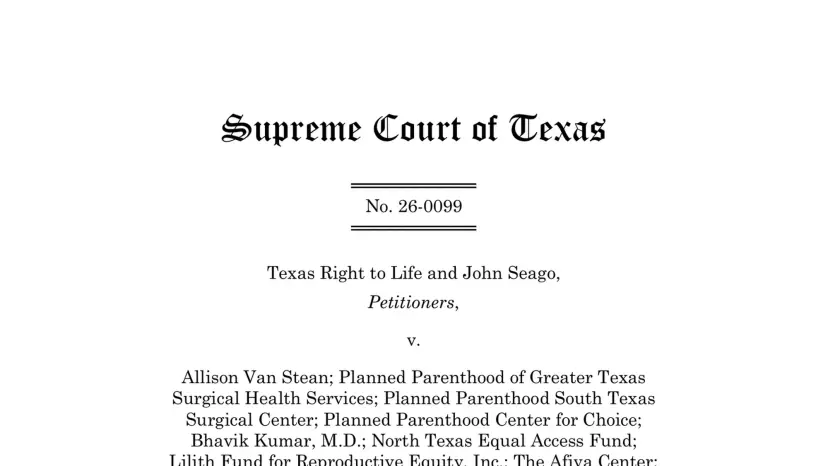

The Texas Supreme Court on Friday dismissed the consolidated lawsuits filed in 2021 by Planned Parenthood clinics and abortion funds, among others, against Texas Right to Life over the Texas Heartbeat Act. In an unsigned opinion, the court held that “there is no justiciable controversy before us,” vacated the rulings of the trial court and the Third Court of Appeals, and dismissed the case for want of jurisdiction.
The Legislature passed the Heartbeat Act in 2021. It bars a physician from performing an abortion once a heartbeat is detectable and provides that it “shall be enforced exclusively through . . . private civil actions,” with statutory damages of at least $10,000 for each violation. Fourteen lawsuits were filed shortly after the Act took effect. They named Texas Right to Life and its director, John Seago, because the group had announced plans to sue under the Act, and they sought a declaration that parts of it are unconstitutional and an order barring such suits. A Travis County trial court denied the group’s motions to dismiss and granted the plaintiffs declaratory and injunctive relief in part.
The case was still on appeal in 2022 when the U.S. Supreme Court decided Dobbs v. Jackson Women’s Health Organization. That ruling triggered a separate Texas law, the Human Life Protection Act, which took effect in August 2022 and, with certain exceptions, prohibits abortion under criminal and civil penalties.
This year, after Texas Right to Life petitioned for review again, the plaintiffs asked the court to dismiss their own case as moot. According to the plaintiffs, in a position Texas Right to Life had also taken, no Texas physician has performed a prohibited abortion since August 2022, and a suit under the Heartbeat Act must be brought within four years of the violation, so the plaintiffs no longer face any threat of one. Texas Right to Life and Seago answered that the plaintiffs never had standing in the first place. “Whether there was never a justiciable controversy at all or there used to be one that has since evaporated, nothing remains in this case for the judiciary to resolve,” the court wrote.
The court also turned aside the group’s argument that its claims for attorney’s fees, including under the Uniform Declaratory Judgments Act (UDJA), kept the case alive. The plaintiffs had withdrawn their own fee requests, and the court held that Texas Right to Life’s “belated claim for attorney’s fees under the UDJA cannot revive an already moot case.” The opinion notes that state law lets a party seek fees in a separate suit and says the court expresses “no opinion regarding the merits of such a claim.”
The case ends without any ruling on whether the Heartbeat Act is constitutional. It began over a law the Legislature wrote to be enforced only through private lawsuits, and it ended because of two other decisions the Legislature made: a separate ban that took effect after Dobbs, and a four-year limit on suits under the Heartbeat Act. That limit has now run. The challenge was filed in a Texas court against a Texas statute, and it ended there, with a deadline in Texas law deciding when the threat of a suit had passed.
See more of the Partisan in Google’s Top Stories.Add as a Preferred Source on Google
Read Next

Texas Supreme Court Declines Cities’ Appeal Over 2023 Preemption Law
The Texas Supreme Court denied review in the cities' challenge to House Bill 2127, leaving in place a ruling that they lacked standing. No appellate court has ruled on the law's constitutionality.