
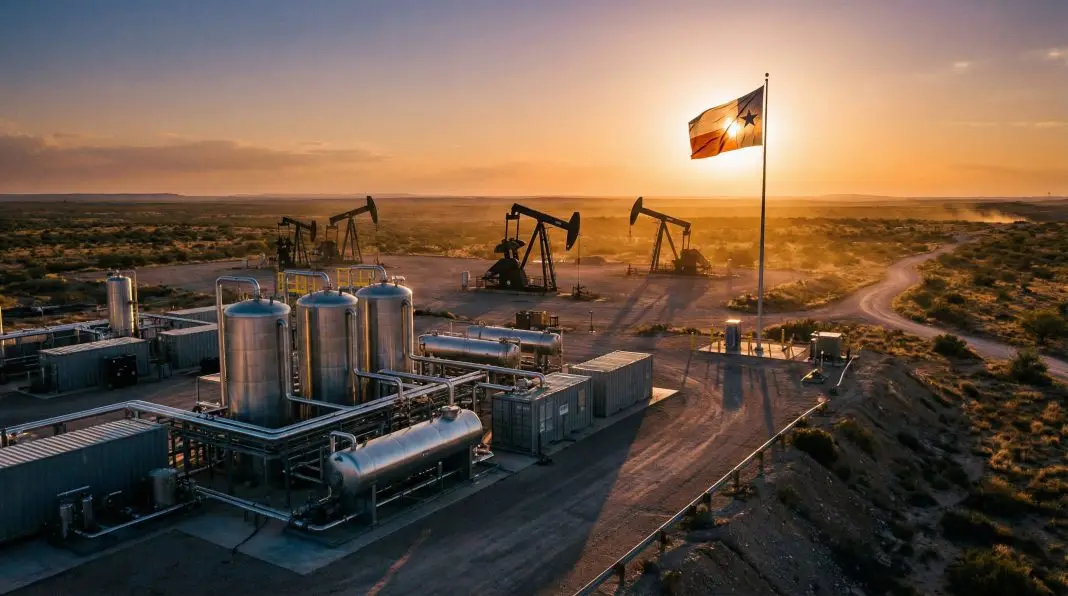

America’s first lithium extraction facility that pulls the critical mineral from oilfield wastewater opened this week in the Permian Basin, positioning Texas alongside Chile, Australia, and China as a major lithium producer.
Element3 Resources opened its 3,000 ton-per-annum lithium carbonate facility, launching the first new lithium mining operation in the United States in more than 50 years. The Fort Worth-based company developed a patent-pending process that extracts lithium from oil and gas wastewater with an 85% recovery rate.
While Washington debates energy policy, Texas builds capacity. The state isn’t just producing oil and gas—it’s turning what others call waste into the strategic resources that power modern economies.
The timing matters. Texas now controls domestic production of a mineral that nations compete to secure. Lithium powers electric vehicle batteries, energy storage systems, and military defense applications. Most countries import it. Texas extracts it from a resource stream that already exists.
The Economics of Resource Independence
Nations measure strategic capacity by their ability to secure critical resources. Chile supplies 26% of global lithium. Australia produces 47%. China controls processing. Texas just entered that conversation.
Element3’s facility doesn’t compete with traditional lithium mining—it exploits Texas’ existing infrastructure. The Permian Basin produces oil. That process generates wastewater. Element3 turns that wastewater into lithium carbonate, the refined form that battery manufacturers need.
The company founded in 2021 saw what others missed: Texas oilfields contain dissolved lithium in concentrations that make extraction economically viable. Their proprietary technology captures it before the water gets disposed. First commercial production began in Q1 2026.
Texas already operates another piece of this supply chain. Tesla’s lithium refinery in Corpus Christi went online in January 2026, processing raw lithium into battery-grade material. Between Element3’s extraction and Tesla’s refining, Texas now controls both ends of domestic lithium production.
Compare that to other states. California imports lithium for its electric vehicle mandates. Colorado studies lithium deposits but hasn’t produced commercial quantities. Nevada mines lithium but ships it overseas for processing. Texas extracts, refines, and supplies.
Federal Energy Policy vs. Texas Energy Reality
The federal government spent four years attempting to eliminate the oil industry that made this lithium facility possible. Washington pushed electric vehicle mandates while opposing the hydrocarbon production that enables lithium extraction from oilfield operations.
Texas ignored the contradiction and built infrastructure. The state’s oil and gas expertise didn’t disappear when federal regulators demanded it—it evolved. Element3’s technology exists because Texas engineers understand reservoir chemistry, fluid dynamics, and large-scale industrial processing. That knowledge comes from decades of energy production that federal policy now treats as obsolete.
The Biden administration celebrated electric vehicles while blocking drilling permits. Element3 proves those positions were never compatible. You can’t build a battery economy without the industrial base that traditional energy production creates.
Texas demonstrated a different approach: use what you have to build what you need. The state’s oil industry generates wastewater as a byproduct. Federal policy would simply regulate that wastewater’s disposal. Texas found a way to monetize it.
What Independent Nations Do
Resource sovereignty defines modern nation-states. Countries measure their strategic position by what they control—not what they can buy.
Chile built its economy around copper and lithium reserves. Norway’s sovereign wealth fund runs on oil revenue. Australia exports iron ore and lithium to Asia. These nations structured their entire economic model around resource extraction and export.
Texas now joins that calculation. The state produces more crude oil than any OPEC member except Saudi Arabia. It generates more electricity than most nations. It controls port infrastructure for global trade. Now it extracts lithium at commercial scale.
Element3’s facility represents 3,000 tons per year of lithium carbonate production. That’s a fraction of global supply—but it’s domestic supply. Texas companies don’t need to negotiate with Chilean mining firms or Chinese processing facilities. They source it from the Permian Basin.
This matters for national security, except Texas isn’t securing the nation—it’s securing Texas. Defense contractors building batteries for military systems can source lithium from Texas instead of from overseas. Electric vehicle manufacturers in Texas can avoid international supply chains. Energy storage systems supporting the Texas grid can use Texas-produced lithium.
The federal government talks about “supply chain resilience” and “critical minerals strategy.” Texas just built both.
The Permian Basin Becomes a Lithium Basin
Element3 isn’t finished. The company’s technology proved the concept—oilfield wastewater contains economically recoverable lithium concentrations. Now the question becomes scale.
The Permian Basin produces 5.8 million barrels of oil per day. That’s more than 60% of total U.S. oil production. Each barrel generates associated wastewater. If Element3’s process works at scale, Texas could produce enough lithium to supply a significant portion of domestic battery production.
Other companies will follow. Exxon announced pilot projects to extract lithium from its Permian operations. Occidental Petroleum studied similar technology. When a Fort Worth startup proves a concept works commercially, major energy companies pay attention.
Texas might accidentally build a lithium industry larger than its original oil production targets. That’s what happens when you optimize for resource extraction instead of environmental regulation.
Washington Wants Mandates, Texas Builds Infrastructure
Federal electric vehicle policy demands results without creating the capacity to deliver them. Washington mandates that automakers sell EVs, then blocks the mining permits that would supply the lithium those vehicles require. California orders a transition to electric power, then imports the batteries from overseas manufacturers.
Texas took a different path. The state didn’t mandate lithium production—it enabled it. Element3 built its facility under Texas regulatory authority, drawing on Texas energy expertise, funded by investors who understood the Permian Basin’s resource potential.
Nobody in Washington planned this. Federal lithium strategy focuses on Nevada deposits and international agreements. Element3 succeeded because Texas provides the infrastructure, expertise, and regulatory environment where resource companies can operate.
This is how independent economies develop—not through mandates, but through industries that adapt to opportunity. Texas has the oil. Oil generates wastewater. Wastewater contains lithium. Engineers figured out how to extract it. Companies raised capital to build facilities. Now Texas produces lithium.
That’s nation-building through market efficiency. Texas didn’t need a federal strategy. It needed companies that understood resource chemistry and state regulators who approved permits.
The Independence Infrastructure Dividend
Every lithium ton Element3 extracts from Permian wastewater represents capacity that Texas controls. Not the federal government. Not international mining conglomerates. Texas companies, using Texas resources, on Texas land.
This is what sovereignty looks like in practice. Nations that control their resources determine their own economic policy. Nations that import resources accept the terms their suppliers offer.
Texas just moved from the second category toward the first. The state already controlled energy production. Now it controls lithium extraction. That’s the resource base modern economies require.
When the federal government finally admits that electric vehicle mandates need domestic battery supply chains, Texas will already be producing the lithium those batteries require. When national security officials realize that military systems can’t depend on Chinese-processed lithium, Element3’s facility will be operating at commercial scale.
Texas built independence infrastructure while Washington debated energy transition policy. That’s not an accident. That’s what happens when a state operates like a nation.

