On the Redbacks, Texas Monthly Asked Washington’s Question. Ours Is Different.


A magazine that markets itself as “national” instinctively writes from Washington’s perspective. A Texan reads Article I, Section 10 differently.
Texas Monthly ran a long piece this week asking whether the State of Texas, in producing the Modern Texas Redback and the new State of Texas Lone Star Coins, has “crossed a constitutional line.” Sasha von Oldershausen handled the assignment with the care Texas Monthly readers expect. The piece is well-sourced and well-structured. It is also, in the most revealing way possible, a Texas Monthly piece.
A magazine that brands itself “The National Magazine of Texas” has been telling Texans what Texas is for half a century, and it has been getting Texas wrong for most of them. The questions Texas Monthly asks are the questions a magazine with one foot in Austin, one foot in Manhattan, and a wandering eye toward Washington asks. Has Texas overstepped? Has the state gotten too uppity? Has Austin offended the constitutional sensibilities of the federal capital? These are not the questions Texans ask. The question Texans ask, reading the same facts, is the opposite one: why on earth did this take so long?
Read the Whole Sentence
Start with the Constitution, since Texas Monthly invoked it. Article I, Section 10 does not say what the piece’s framing implies. The full sentence reads: “No State shall … coin Money; emit Bills of Credit; make any Thing but gold and silver Coin a Tender in Payment of Debts.”
The Constitution does not forbid gold and silver as state tender. It commands them. It says, in plain English, that gold and silver are the only forms of tender a state is permitted to recognize. Every state in the federation has a constitutional obligation to honor that command. For most of the last century, every state has ignored it, deferring instead to a federal fiat regime that Article I, Section 10 plainly does not contemplate. Texas, finally, is not.
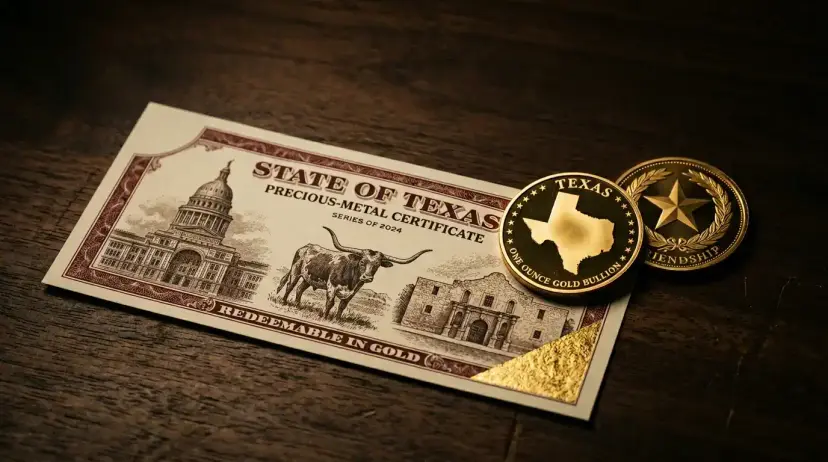
Governor Abbott signed House Bill 1056 last summer, recognizing gold and silver as legal tender in Texas and authorizing the Comptroller to build out a transactional system tying bullion held at the Texas Bullion Depository to point-of-sale purchases. Beginning next May, a Texan with metal in Leander will be able to walk into an H-E-B and buy groceries with a debit card backed by gold. The Modern Redbacks and the State of Texas coins are, among other things, retail-friendly expressions of that same return to constitutional money.
Texas Monthly framed all of this as a question of whether the state has gone too far. The honest framing, the one a publication actually rooted in Texas would have led with, is that the state finally went far enough to matter.

Yes, This Is About Sovereignty. Good.
The Texas Nationalist Movement has been making this case publicly since 2005. We supported House Bill 483 in 2015 when it created the depository. We supported House Bill 1056 in 2025 when it made the metal spendable. We will support the next legislative step in 2027 when the 90th Legislature convenes. The reason is straightforward: a Texas that can store, transact, and settle in metal of its own holding is a Texas with monetary tools that do not depend on Washington’s permission to function.
Texas Monthly’s piece dances around this point without quite stating it. Tarek Saab, the CEO of Texas Precious Metals, told the magazine the program “feels like the Texas dollar” and raises “real, really big constitutional questions.” Texas Monthly presents that framing as a concern. We present it as an observation. Yes, the State of Texas is producing precious-metal instruments under the state seal, redeemable in physical gold, increasingly tied to a transactional payment system. Yes, that infrastructure resembles, in its broad outlines, the monetary architecture of a sovereign state. Yes, the resemblance is not accidental. Yes, we are in favor of it.
The question Texas Monthly tiptoes around is the one TNM has been asking out loud for two decades: should Texas be capable of operating monetarily as a sovereign? The federal Constitution permits it. The Texas Constitution does not forbid it. The infrastructure now exists to do it. The political will, measured in poll after poll, is overwhelmingly behind it. The Redbacks are not a violation of the constitutional order. They are a quiet, technical, unglamorous brick in a foundation that Texans, when they finally cast a vote on independence, will be glad to have built.
The Trademark Claim Is the Worst Part of the Lawsuit
Then there is the lawsuit. Texas Precious Metals of Shiner sued the Comptroller in February. Their CEO has worked the press skillfully, casting the case in interviews as a constitutional concern about a “Texas dollar.” The legal filings tell a smaller story. The complaint rests on two claims: that the Comptroller exceeded the statutory authority granted under House Bill 483 and House Bill 2458, and that the State of Texas coins infringe on the company’s federal trademark in the outline of Texas, which Texas Precious Metals uses as a privy mark on its private Texas Mint product line.
Set aside the statutory question for a moment (it is real, and we will return to it) and look at the trademark claim. A private company is asserting, in federal court, that the State of Texas cannot stamp the outline of Texas on a Texas coin sold by the Texas Bullion Depository because the company has been doing it for fifteen years. The shape of Texas is on every license plate, every state seal, every county courthouse, every flag-adjacent piece of Texas iconography stretching back to the Republic. Sixth-generation Texans grew up tracing it in elementary school. The notion that any private entity can carve out commercial exclusivity over the most recognizable geographic silhouette in the federation, even narrowed to one product category, is trademark maximalism of the sort that makes ordinary people lose faith in the system.
The shape of Texas belongs to Texans. It is not a corporate asset. And whatever the company’s intent in bringing the suit, the practical effect of the trademark claim is to invite a federal judge to police the State of Texas’s use of its own seal on its own metal in a domain the federal Constitution explicitly reserves to the states. We are not interested in that supervision. Neither, we suspect, are most Texans.
The One Question Worth Asking
The narrower statutory question is the part of the lawsuit that actually deserves attention. HB 483 authorized the Comptroller to operate a custodial depository. HB 2458 in 2019 authorized the sale of “promotional items.” Whether the design, manufacture, and retail sale of $6,842 gold proof coins falls within “promotional items” is a fair question. Reasonable Texans can disagree about it.
But the proper forum for that disagreement is the 90th Texas Legislature in 2027, not a federal court presided over by a judge who joked at last month’s hearing that he wished he had bought gold instead of United Airlines stock. If the Comptroller has stretched the statute too far, the Legislature can clarify the authority. That is how sovereignty exercises mature: through Texas institutions, on Texas timelines, in Texas hands. We are perfectly willing to debate the contours of the depository’s commercial mandate in the Capitol. We are not willing to outsource that debate to a federal courtroom in Austin.
The First Redbacks and the Lesson They Left
The original Redbacks, issued by President Mirabeau Lamar in 1839, failed because the young Republic overprinted them and could not back them with metal. At their worst, a Republic of Texas dollar traded for two cents on the United States dollar. The collapse fed the broader pressure for annexation, and by 1845 the first experiment in Texas sovereignty was over.
The Modern Redbacks are different. Each one is the metal. They are not Lamar’s IOUs in fancier dress. They are gold, in measured centigrams, in a form a Texan can hold in his hand. The lesson the first Republic left for the second is exactly this: sound money is not a slogan, it is a discipline. If the Comptroller, the Legislature, and the courts handle this program with the seriousness it deserves, the Modern Texas Redback will be remembered not as a “short-lived political novelty item,” as Texas Monthly predicts, but as one of the foundational pieces of monetary infrastructure that made Texas independence possible.
A Closing Note for the Austin Glossies
Texas Monthly is welcome to keep asking Washington’s questions. That is, evidently, the editorial brief. We will keep asking ours. They are not the same questions, and they will not yield the same answers. Theirs lead to a Texas that exists at the sufferance of a federal government a continent away. Ours lead to a Texas that governs itself.
We know which version of Texas Texans actually want. The polling has been clear for a decade. The infrastructure is being built. The legislative pieces are falling into place. The Redbacks are part of that story whether or not Texas Monthly chooses to see it. The question is not whether Texas crossed a line. The question is when, exactly, the rest of the conversation catches up to where Texans already are.
See more of the Partisan in Google’s Top Stories.Add as a Preferred Source on Google
Read Next

Washington Asks Supreme Court to Let It Build Border Barriers Through Big Bend
The Solicitor General asked the Supreme Court to lift an El Paso court's order halting about 340 miles of border barrier and road work in the Big Bend Sector.