
The Texas First Pledge Now Has a Permanent Home

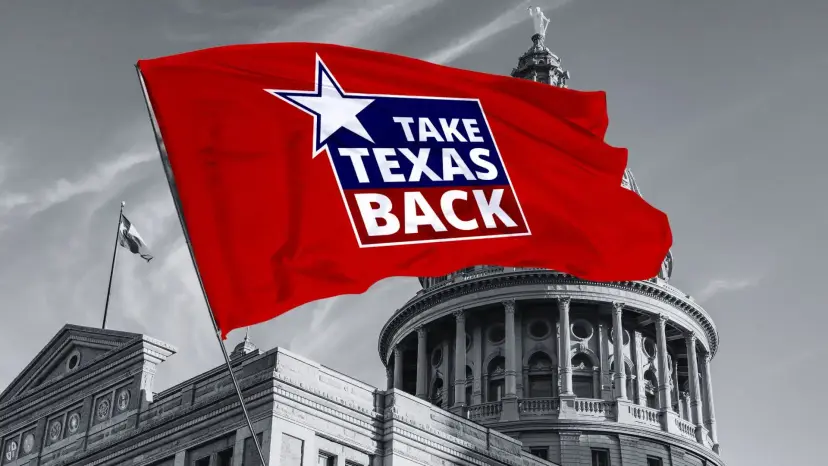

The Texas Nationalist Movement has rebuilt taketexasback.com, the home of the Texas First Pledge. The old site had run its course, and the pledge had outgrown it. The new one keeps a permanent, public record of everyone who has signed the pledge to put Texas first. Type in your address and the site shows you in seconds whether the people who represent you are on it.
What the pledge is
The Texas First Pledge is four sentences. Here is the pledge in full, word for word:
- I pledge to place the interests of Texas and Texans before any other nation, state, political entity, organization, or individual.
- I further pledge to uphold the right of Texans under Article 1 Section 2 of the Texas Constitution “to alter, reform or abolish their government.”
- If it is within the powers of my office, I will vote for legislation and resolutions to call for a vote on Texas reasserting its status as an independent nation in every term that I am elected until such a referendum is held.
- If a majority of the people of Texas vote in support of Texas reasserting its status as an independent nation, I pledge to work toward a fair and expedient separation of Texas from the federal government placing the interests of Texans first.
Signing is not a vote for independence, and it is not an endorsement by the Texas Nationalist Movement. A signer agrees to put Texas first and to respect the right Texans already have to determine their own future. Whether Texas reasserts its independence is for Texans to decide at the ballot box, and the pledge commits a candidate to making sure that vote actually happens.
That right is written into the Texas Constitution. Article I, Section 2 puts all political power in the hands of the people of Texas and leaves them free to change their government whenever they see fit. The pledge only asks officeholders to respect it.
Open to everyone, owned by no party
Any candidate or officeholder in Texas can sign, whatever their party, and the roster already crosses party lines. Party has nothing to do with the standard. A signer is anyone willing to put Texas ahead of every other claim on their loyalty.
The proof
More than 260 Texans have signed, and the number keeps growing. They include current officeholders and candidates on the ballot now, along with people who sought office in past elections. Their signatures span 33 different offices, from Governor and U.S. Representative down to precinct chair, and the signers come from more than 100 Texas cities.
The pledge also wins elections. TNM’s analysis of the March 3, 2026 Republican primary found that about 1.6 million Texans, three out of four of everyone who voted in it, cast a ballot for at least one signer. Signers won at every level of that primary, statewide offices and county chairs alike. The homepage names them.

Tools for every voter
Enter your address and the site pulls up your Texas House, Texas Senate, and U.S. Congressional districts and tells you which of the people representing you have signed. A separate page collects the current officeholders who have not, sorted by office, with a one-tap way to ask each of them, on the record, to put Texas first. The site lets you put that same question to any candidate and share the answer. The full roster is searchable by office, party, year, and record status, so the whole register is open to anyone who wants to dig through it. For anyone who wants to check the work, the site also documents how the accountability pages are built and how to flag a mistake.
The record is permanent
A name does not come off when it turns inconvenient. If someone signs and later backs away or breaks the pledge, that goes on their profile too, with the date. The record keeps its uncomfortable entries, because one that hides them would be worth nothing.
Put it on the record
A candidate or officeholder signs at taketexasback.com/sign. It takes a few minutes, and the signature becomes a public profile that tends to rank at the top when someone searches the candidate’s name.
Everyone else has an even simpler job. Go to taketexasback.com, enter your address, and see whether the people who represent you have signed. If they have not, ask them to sign it, and ask why they have not already.
See more of the Partisan in Google’s Top Stories.Add as a Preferred Source on Google
Read Next
Comptroller Huffines Bars State Contracts for Businesses That Demand COVID Vaccine Papers
Comptroller Don Huffines ordered that businesses demanding COVID-19 vaccination or recovery papers from customers cannot receive his agency's contracts or grants, enforcing a 2021 state law.