Texas Republicans Are Leaving the GOP. Which One?

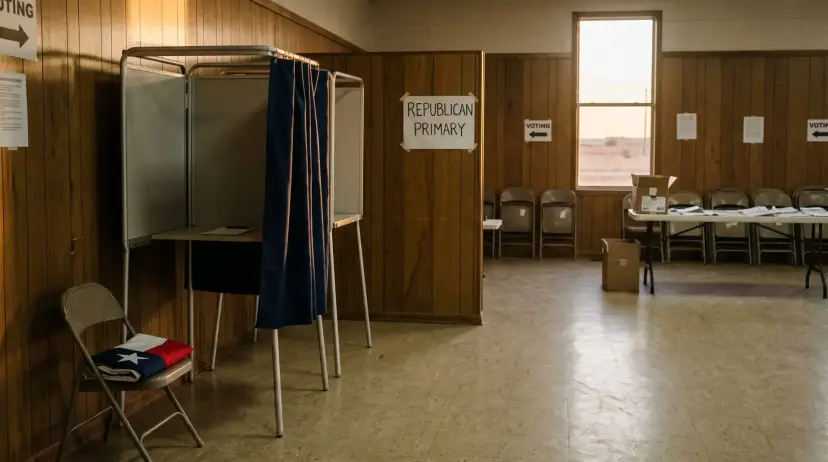

A Republican polling firm has documented what it calls a “troubling pattern” of historically reliable Texas Republican primary voters either sitting out the 2026 cycle or crossing into the Democratic primary, but the firm’s coding scheme treats federal and state Republican grievances as a single category, leaving the most consequential question about Texas’s political realignment unanswered.
The memo, released May 11 by Ragnar Research Partners, is built on 4,269 terminated voter interviews collected across 23 Texas districts in the closing weeks of the 2026 primary. Ninety-one percent of those voters had participated in at least one of the last four Texas primaries. Thirty-one percent were high-propensity voters who had participated in three or four of the last four.
The top reason these voters gave for not casting a Republican primary ballot in 2026 was that they were unhappy with the direction of the Republican Party. Twenty-eight percent of all screened-out respondents named that reason. Among voters with Republican histories who actually crossed over and voted in the 2026 Democratic primary, the figure climbs to 52 percent.
But Ragnar’s coding makes no distinction between disaffection with the federal Republican Party in Washington and disaffection with the Texas Republican Party in Austin. The two are entirely different political diagnoses, and they point to entirely different strategic conclusions about whether the voters in question are recoverable.
What Ragnar Did Carve Out
The firm did separate out one federal-specific bucket. Twelve percent of all screened-out voters told Ragnar they were unhappy with the “current administration,” meaning the Trump White House. That share rises to 27 percent among voters who actually crossed into the Democratic primary. Among high-propensity Republican primary voters who voted Democratic in 2026, Ragnar reported that roughly one in four cited Trump or the administration as a reason for leaving, and 24 percent volunteered that the GOP had “changed” or “left them.”
That carve-out isolates the federal executive. It does not isolate the rest of federal Republicanism: the congressional GOP’s posture on spending, foreign entanglements, surveillance authorities, or its repeated failure to deliver on stated priorities. Nor does it isolate Texas Republicanism: the state party’s intramural war between the establishment and grassroots factions, the Speaker fights, the legislative cycles that end without delivering on property tax elimination, border enforcement, or the TEXIT referendum that has been a plank of the Texas GOP platform since 2022.
All of those grievances, federal-legislative and Texas-state alike, would have been coded into Ragnar’s single “Direction of the Republican Party” bucket. A suburban Republican who is exhausted with Washington’s foreign policy and a grassroots Republican who is exhausted with Austin’s establishment caucus would appear identically in the published table.

The Behavioral Data
Whichever party the defectors are walking away from, they are in fact walking. When Ragnar’s interviewers terminated surveys with voters who indicated they would not be participating in the Republican primary, the firm asked what those voters intended to do instead. Forty-one percent said they would not vote in any primary. Thirty-two percent said they would vote but were unsure in which primary. Twenty-seven percent said they intended to vote in the Democratic primary.
Ragnar then cross-referenced those stated intentions with L2 voter file records of actual primary turnout. Among voters who said they would not vote at all, 60 percent stayed home. Among voters who said they were unsure which primary to vote in, 49 percent stayed home and only 43 percent ended up voting Republican. Among voters who said they intended to vote in the Democratic primary, 40 percent stayed home, 30 percent followed through and voted Democrat, and only 26 percent returned to the GOP primary.
“Once high propensity voters say they’ll vote Dem, we need to listen to them,” the memo states. “Over half of our most reliable voters who said they’d switch parties either stayed home or voted Democrat this year.”
The defection pattern is sharpest in suburban Texas. Among suburban respondents who told Ragnar they planned to vote in the Democratic primary, 37 percent did so, a figure that held steady across vote history. Thirty-seven percent of low-propensity suburban voters who said they would vote Democrat did so; 36 percent of high-propensity suburban voters did the same.
The Stakes Beyond the Primary
Ragnar argues the magnitude of the disengagement matters well beyond the primary calendar. Citing L2 turnout records for registered Texas voters, the firm notes that high-propensity Republican primary voters made up roughly 10 percent of the Texas general electorate in 2024 and 13 percent in 2022. Low-propensity Republican primary voters made up 18 percent of the 2024 general electorate and 22 percent of the 2022 general electorate. Combined, those two cohorts are a foundational block of any statewide Republican coalition in November.
“The bad news is that low propensity RPVs who said they wouldn’t show up, didn’t,” the memo states. “And that should be a real red flag as we look forward to the general elections.”
Ragnar recommended that its political clients revise their likely-voter survey methodology for 2026, building “an explicit enthusiasm and turnout mechanism” into survey design to detect base voters who have checked out. The firm warned that conventional likely-voter screens can mask the absence of disengaged base voters until it is too late to mobilize them.
The Question the Data Leaves Open
The methodological limitation in Ragnar’s published coding has direct implications for how the 2026 general election should be read. If the voters defecting from the Republican primary are leaving Washington Republicanism while remaining open to a Texas-focused politics, they represent a recoverable electorate whose attachments to Texas-level governance are intact. If they are leaving Texas Republicanism itself, frustrated with the state party’s performance after a generation of supermajority control, they represent a different problem entirely, one that no amount of federal-level repositioning is likely to address.
The verbatim responses Ragnar collected almost certainly contain the distinction. Respondents who object to Trump or to federal Republican direction tend to say so in plain language, as do respondents who object to specific actions of the Texas Legislature or the state GOP leadership. The firm’s decision to collapse those grievances into a single category is a standard convention in survey research, which has historically treated partisan attachment as a single relationship to “the party” rather than as a layered attachment to distinct federal and state organizations.
For Texans watching this data, the unaddressed question is whether the defectors believe the Republican Party of Texas can still deliver on the things Texans want from their own government, or whether they have concluded that the party at every level has stopped representing them. Ragnar’s published memo cannot answer that question. The raw verbatims, recoded for the federal-versus-state distinction, almost certainly could.
Ragnar Research Partners is a Republican-aligned polling firm and a member of the American Association for Public Opinion Research. The full memo, titled Analysis of Republican Voters Not Participating in the 2026 Texas Primaries, is available on the firm’s website.
See more of the Partisan in Google’s Top Stories.Add as a Preferred Source on Google
Read Next
Comptroller Huffines Bars State Contracts for Businesses That Demand COVID Vaccine Papers
Comptroller Don Huffines ordered that businesses demanding COVID-19 vaccination or recovery papers from customers cannot receive his agency's contracts or grants, enforcing a 2021 state law.