Texas’s Newly Elected Leaders Drew Far More Money From Outside the State
Texas's new statewide officials took 33.7 percent of their itemized money from outside Texas, against 12.6 percent for the officials they beat, and most of the U.S. House delegation raised more than half outside the state.


The statewide officials Texans elected on Tuesday raised a much larger share of their campaign money outside Texas than the candidates they defeated. The seven Democrats who won the statewide executive offices took 33.7 percent of their itemized contributions from donors with addresses in other states, according to Texas Ethics Commission filings through October 24. The seven Republicans they beat took 12.6 percent.
Most of that gap is the governor’s race. Gov.-elect Gina Hinojosa took 39.4 percent of her $39.4 million in itemized contributions from outside Texas, about two of every five dollars. Gov. Greg Abbott took 17.1 percent of his $117.6 million.
Neither share is new. In 2022, Beto O’Rourke’s campaign for governor took 39.5 percent of its itemized money from outside Texas, and Abbott’s took 18.2 percent, counting contributions dated 2021 and 2022 in the commission’s filings. The shape of the money in the governor’s race barely moved in four years. What changed on Tuesday is that the candidate who raised two of every five dollars outside Texas won.
The largest block of Hinojosa’s out-of-state money came from addresses in Washington, D.C., about $4.1 million, ahead of California at $2.7 million, Illinois at $1.7 million and New York at $1.0 million. Most of the Washington money came from national committees. The Democratic Senatorial Campaign Committee gave her campaign $1.49 million and DGA Action, tied to the Democratic Governors Association, gave $1 million, with $250,000 apiece from the political arms of the American Federation of Teachers and the National Education Association. Abbott drew from Washington’s party committees too. RGA Right Direction PAC, tied to the Republican Governors Association, gave his campaign $3 million, and the Chickasaw Nation of Oklahoma gave $1.2 million. His largest out-of-state totals by address were California at $4.1 million, Washington, D.C., at $3.4 million, Pennsylvania at $3.2 million and Oregon at $2.6 million.
Further down the ballot the shares were smaller, but the winner drew more from outside Texas than the loser in all six other races. Railroad Commissioner-elect Jon Rosenthal took 26.1 percent from outside Texas, against 7.5 percent for Bo French. Agriculture Commissioner-elect Clayton Tucker took 16.3 percent and Comptroller-elect Sarah Eckhardt 14.4 percent, against 3.8 percent for Nate Sheets and 9.4 percent for Don Huffines. Lt. Gov.-elect Vikki Goodwin took 11.5 percent to Lt. Gov. Dan Patrick’s 8.8 percent, and Attorney General-elect Nathan Johnson took 6.0 percent to Mayes Middleton’s 1.9 percent. Land Commissioner-elect Benjamin Flores raised only $80,635 in itemized money, 37.0 percent of it from outside Texas, against 4.4 percent for Land Commissioner Dawn Buckingham.
The same shift shows up in the Texas House. In the 21 Republican-held House seats where a Democrat won or leads, the Democrats took 16.7 percent of their itemized money from outside Texas, and the Republicans they defeated took 1.9 percent. The winner’s out-of-state share was higher than the loser’s in 20 of the 21. Tyler Smith, who won House District 138, took 42.3 percent from outside Texas, against 4.3 percent for Rep. Lacey Hull. Kristian Carranza in House District 118 took 28.5 percent, against 0.8 percent for Jorge Borrego, and Zack Dunn in House District 121 took 18.9 percent, against 1.0 percent for Rep. Marc LaHood.
Across the whole incoming House, counting the candidate who leads in each of the 150 districts, the 83 Democrats took 12.5 percent of their itemized money from outside Texas and the 67 Republicans 6.2 percent. The shift does not reach the top of the chamber. Rep. Senfronia Thompson, who says a majority of the House has pledged to make her speaker, took 11.9 percent of her itemized money for her own House race from outside Texas, almost exactly the 11.8 percent Speaker Dustin Burrows took. In the Texas Senate, the 16 senators elected Tuesday took 9.0 percent, with little difference between the parties.

Outside money is still the smaller part of what Texas state candidates raise. Across every state race on the ballot, 85.4 percent of itemized contributions came from Texas addresses and 12.9 percent from other states. The change is in who is taking office. The Republicans who lost the statewide races raised more than 85 percent of their itemized money in Texas, and more of the money behind the officials arriving came from somewhere else.
The seats in Washington
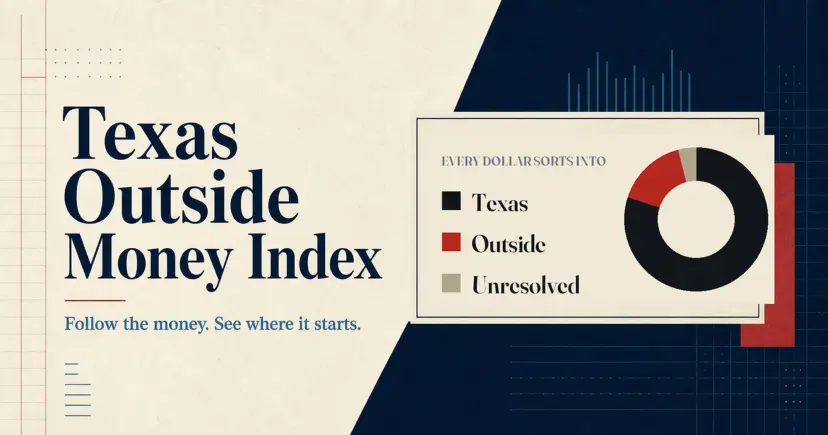
Federal races run on outside money as a matter of course, and the delegation Texas just elected is no exception. The campaigns of 36 of the 38 winners in Texas’s U.S. House races took 57.0 percent of their money from outside Texas, according to the Texas Outside Money Index, which the Texas Nationalist Movement (TNM) publishes from Federal Election Commission (FEC) filings through early October. The two missing winners have no committee in the index yet. The share was nearly the same in both parties: 57.9 percent for the Republicans and 55.6 percent for the Democrats. Twenty-two of the 36 raised more than half their money outside Texas. Rep. John Carter’s campaign took 81.4 percent from outside Texas and Rep. Ronny Jackson’s 79.3 percent. Reps. Roger Williams and Brian Babin, who chair House committees until January, took 73.0 and 71.4 percent.
In the U.S. Senate race, the index puts Sen.-elect James Talarico at 45.2 percent from outside Texas, led by California, and Attorney General Ken Paxton at 20.5 percent. Sen. John Cornyn, whose seat Talarico will take, drew 61.3 percent of his 2026 campaign money from outside Texas by the index’s count. FEC figures through October 14 give nearly the same split for Talarico and Paxton on the itemized money the agency has sorted by state, 45 percent and 17 percent. More than half of Talarico’s $146.3 million, $75.3 million, came in amounts small enough that the campaign did not have to report an address at all. Committees spending on their own in the race reported about $425 million in the general election, and the largest, Texas PAC, received its $158 million through Senate Leadership Fund, the super PAC aligned with Senate Republican leadership in Washington.
Each share reflects the address a donor gave on a public filing, which can be a second home or an office, and the state figures cover itemized contributions through October 24. Contributions after that date appear on reports due January 15, 2027.
TNM, which publishes the index, argues that the share matters more than the total. “Out-of-state money does not decide who wins. It decides who the winner owes,” the index states in explaining why it measures the share. It cites a 2024 study in the journal Political Behavior, in which Georgians told that a candidate in the 2021 U.S. Senate runoffs was funded by out-of-district donors expected that senator to spend less time and effort on Georgia’s interests, and a 2024 study in Political Research Quarterly that found out-of-state donors reward senators for their positions on federal issues rather than their work at home.
By that measure, the governor-elect will take office having drawn two of every five itemized dollars from outside Texas, with the federal party committees in Washington among her largest donors. And 22 of the 36 House members in the index whom Texas is sending to Washington drew more than half their money from donors with addresses outside Texas.
See more of the Partisan in Google’s Top Stories.Add as a Preferred Source on Google
Read Next
Trump Moves to Put Ousted Texas Justice James Sullivan on the Federal Bench
President Trump is moving to nominate Texas Supreme Court Justice James Sullivan, whom voters removed from the court Tuesday, to a lifetime federal judgeship in Austin.