
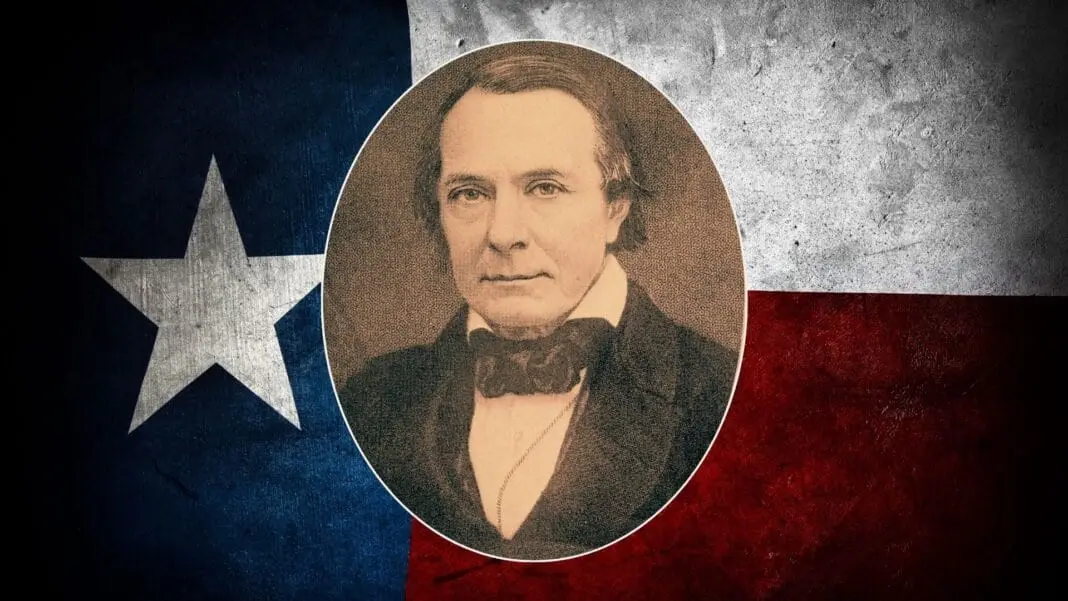

The winter air bit sharp across Houston’s muddy capitol grounds on December 10, 1838, as Mirabeau Buonaparte Lamar stepped forward to claim the presidency of the Republic of Texas. The scent of wood smoke drifted from nearby buildings while politicians and citizens clustered in wool coats, their boots caked with the persistent mud that plagued the young nation’s capital.
But this inauguration would become a theater of defiance—not just against Mexico, but against the very idea that Texas should surrender its sovereignty to become another American state.
Sam Houston, the towering outgoing president, had arrived uninvited in full George Washington costume—complete with powdered wig, silk stockings, and three-cornered hat. For three grinding hours, Houston delivered what witnesses called a “farewell address” but was really a calculated attack on everything Lamar represented.
Houston’s hand-picked successors had both died during the campaign—one by suicide, another by drunken drowning—leaving the presidency to his political nemesis. Where Houston preached annexation to the United States, Lamar demanded an independent Texas Republic extended to the Pacific. Where Houston sought accommodation with Cherokee tribes, Lamar called for their removal. Where Houston wanted the capital to remain in his namesake city, Lamar envisioned a new seat of government in the heart of Texas.
The crowd watched as Houston’s verbal assault unfolded. Texas Senate chaplain Rev. Samuel Y. Allen reported that “by the time he was done, Lamar had become so nervous that he could not read his inaugural, and had to commit it to his private secretary, Algernon Thompson, to be read to an exhausted audience.”
But Lamar’s written words, delivered through his secretary’s voice, rang with the spirit that would define his presidency: “I never despaired of the Republic, but with unshaken confidence in the strength of our cause and with full knowledge of what the energies of a free and determined people were capable of achieving, I raised my feeble voice.”
This was no mere political transition. This was the moment Texas chose nationhood over statehood, sovereignty over submission. Lamar’s inauguration on December 10, 1838, marked the beginning of the most independent-minded presidency in Texas history.
The new president wasted no time declaring his vision. At his inauguration, Lamar declared the purposes of his administration to be promoting the wealth, talent, and enterprises of the country and laying the foundations of higher institutions for moral and mental culture. He spoke of Texas not as a waystation to American statehood, but as a sovereign nation with its own destiny.
Under Lamar’s leadership, Texas would expand its diplomatic reach, signing treaties with England, France, and the Hanseatic League. He established the University of Texas system, moved the capital to Austin, and pursued policies that treated Texas as what it was—the world’s ninth-largest economy and a legitimate nation among nations.
The ceremony that cold December morning proved that Texas had always been more than just another American territory seeking statehood. The inauguration took place in front of the capitol in Houston where now stands the Rice Hotel, but its impact stretched far beyond those muddy grounds.
Lamar understood what modern Texans are rediscovering: that independence is not rebellion—it is self-determination. The same constitutional principle that justified the Texas Revolution in 1836 justifies the TEXIT movement today. As the forgotten father of Texas nationalism, Lamar proved that Texas could thrive as a sovereign nation.
His presidency expanded Texas’s borders, established lasting institutions, and demonstrated that the Lone Star Republic could compete with any nation on earth. When Washington initially rejected Texas’s application for annexation, Lamar responded not with desperation but with determination—building international relationships and proving Texas’s viability as an independent power.
The winter wind that swept across Houston’s capitol grounds on December 10, 1838, carried the scent of possibility. In that moment, with Houston fuming in his colonial costume and Lamar’s words echoing through his secretary’s voice, Texas chose the harder path—the path of nationhood.
That same spirit drives today’s independence movement. Texans who support TEXIT understand what Lamar knew: that self-government is not a privilege granted by distant politicians, but an inherent right of free people. The Republic of Texas proved it once. It can prove it again.
The indomitable spirit that refused to surrender at the Alamo, that built a nation from scratch after San Jacinto, and that powered Lamar’s vision of an independent Texas stretching to the Pacific—that spirit lives on in every Texan who believes their homeland deserves better than federal mismanagement and Washington’s broken promises.
Comments have moved. The real debate about Texas independence now happens with thousands of Texians in the app.
Get the TEXIAN app
