



On the night of September 15, the Collin County Journal, a Dallas-area news page, put a question to its Facebook followers. The Texas GOP platform “calls for a statewide vote on whether Texas should become an independent nation,” the post said. “Should Texans get that vote?”
By Friday the post had drawn 1,700 reactions, 500 comments, and 164 shares. About 1,200 readers hit Like, 292 hit Love, and 206 reacted with a laugh.
Count those reactions like ballots and the result is not close: about 88 percent for, 12 percent against. Set the Likes aside entirely and it still holds: Love, the strongest reaction on the list, outnumbered laughter by roughly three to two.
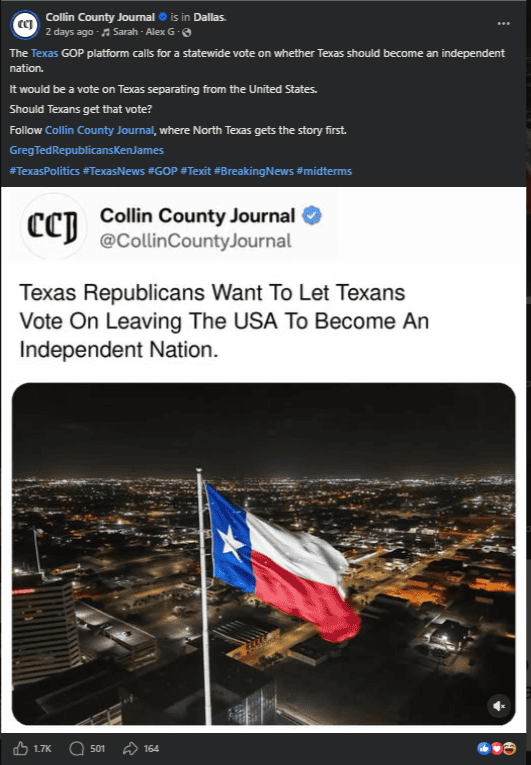
The post had the platform right. The Republican Party of Texas platform says: “The Texas Legislature should pass a bill in its next session requiring a referendum in the next General Election for the people of Texas to determine whether or not the State of Texas should reassert its status as an independent nation.” Delegates kept that plank at the party’s June convention in Houston, and the chair and vice chair they elected are both signers of the Texas First Pledge.
The Texian Partisan read the entire thread, every comment and every reply. It is a rare, unfiltered look at how a general North Texas audience, one never selected for any sympathy with the cause, talks about independence when someone simply asks.
The single most popular comment in the thread made the case for the vote in one line: an independent Texas would rank eighth among the world’s economies. It drew 103 reactions. No comment against independence drew more than 34.
Dozens of readers answered the question with a plain yes. “Where do I vote?” several asked. “I’m all in.” “I would so vote for that.” One wrote, “I’m not a Republican and I say yes.”
The comment count ran the other way. Of the top-level comments that took a side, about four in ten were for independence and six in ten against, many of them one or two words: “No,” “Not legal,” “This again?” But roughly a fifth of the no votes were not about independence at all. They were aimed at the messenger: the party, the governor, the president. Independence is not a party project, and the people who treated it as one were arguing about something else.
The arguing was carried by a small group of supporters who stayed in the thread for two days. When a skeptic claimed the Texas Constitution forbids a vote, one answered with the Texas Constitution itself. When another warned that Washington would use its military to keep Texas, a supporter summed that argument up as “Don’t leave the house or I’ll beat you,” and said it sounds like an abusive spouse, not a free union. When a skeptic cited the law, one supporter answered with a link to the Texas Nationalist Movement’s own answer to the question. Those Texians reached thousands of their neighbors who had never been asked before, and they deserve the credit.
The same handful of objections came up again and again. Every one of them has an answer.
The claim: the Texas Constitution forbids it. Nothing in the Texas Constitution bars a vote. Article 1, Section 1 describes Texas as “a free and independent State, subject only to the Constitution of the United States,” and says the union’s survival depends on “the right of local self-government, unimpaired to all the States.” Article 1, Section 2 says: “All political power is inherent in the people,” and that the people of Texas “have at all times the inalienable right to alter, reform or abolish their government in such manner as they may think expedient.” The United States Constitution contains no clause on a state leaving the union at all.
The claim: Texas v. White settled it. The Supreme Court decided Texas v. White in 1869, during Reconstruction, in a lawsuit over federal bonds. Its famous line about “an indestructible Union” was not needed to decide that dispute. And the same opinion said there was “no place for reconsideration, or revocation, except through revolution, or through consent of the States.”
The claim: consent of the States means a constitutional amendment, so it can never happen. The right to decide does not come from Washington or from the other 49 states. The Texas Constitution already places it with the people, and nothing in the United States Constitution names anyone whose approval a departure requires. What gets negotiated after a vote is the terms of separation, not the right to decide. When Canada’s Supreme Court considered a clear vote for Quebec independence in 1998, it said such a vote would oblige all sides to negotiate. The Partisan answers this objection in full in The Right to Decide Was Never Washington’s to Give.
The claim: the referendum act is really about splitting Texas into five states. That is a different law from a different century. The 1845 joint resolution that annexed Texas allowed “New States of convenient size not exceeding four in number, in addition to said State of Texas” to be formed from its territory with Texas’s consent. It has nothing to do with independence. The Texas Independence Referendum Act would ask Texans whether Texas should become an independent nation.
The claim: Texas depends on federal funding. Leave out the money Washington borrows, and Texans send it more than it sends back: Texas sent about $68 billion more to the federal government than it received in fiscal 2024, according to USAFacts figures compiled in the Texas Nationalist Movement’s “Can Texas Make It?” report.
The claim: Social Security, Medicare and veterans’ benefits would stop. United States citizens already collect Social Security abroad for life, and the Supreme Court held in 1967 that Congress cannot strip Americans of their citizenship against their will. The Department of Veterans Affairs says most VA benefits are payable regardless of residence or nationality. Medicaid, SNAP and WIC are already run in Texas by a Texas agency. The cut actually on the calendar is Washington’s own: its trustees project the retirement trust fund will be depleted in late 2032. The full answer is in Social Security Does Not Stop at the Border.
The claim: Texas could not defend itself. Texas already has a military: the Texas Army National Guard, the Texas Air National Guard and the Texas State Guard, under the Texas Military Department. The Pentagon spent $47.4 billion in Texas in fiscal 2024, more than Canada or Australia spends on its entire armed forces and more than three times Mexico’s military budget. The full answer is in Texas Already Has a Military.
The claim: this is old news, it comes up every convention, and nothing changes. It is true that the plank is not new. What changes now is the calendar. Bill prefiling for the 90th Texas Legislature opens November 9, the Legislature convenes January 12, and the Texas Independence Referendum Act is expected to be filed again. The plank asks that Legislature to act “in its next session.” That session is four months away.
The Collin County Journal asked whether Texans should get that vote. The Texas Constitution answered it 150 years ago: “All political power is inherent in the people.”
Comments have moved. The real debate about Texas independence now happens with thousands of Texians in the app.
Get the TEXIAN app

