
Uvalde Water District Warns 765-kV Line Could Damage Edwards Aquifer Recharge
Uvalde County's groundwater district told the utility commission that the Howard-to-Solstice 765-kV line crosses a high recharge zone for the Edwards Aquifer and could have 'a catastrophic effect.'

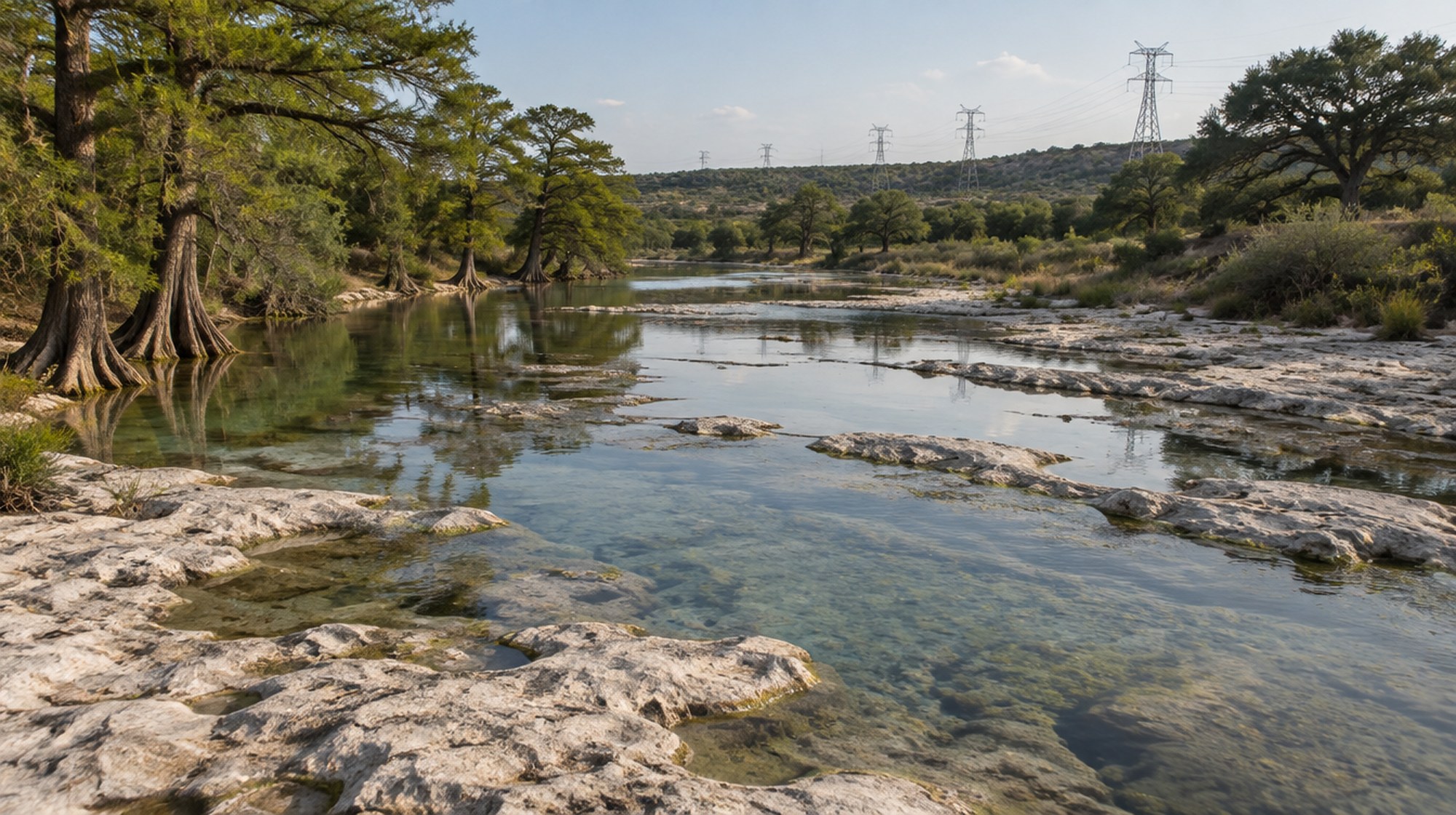

The groundwater district for Uvalde County has warned the Public Utility Commission of Texas that a new 765-kilovolt transmission line approved last month would cross one of the most important aquifer recharge areas in South Texas. Construction “could have a catastrophic effect,” the district wrote.
The Uvalde County Underground Water Conservation District filed the letter October 9 in the docket for the Howard-to-Solstice line, which AEP Texas and CPS Energy will build from southwest San Antonio to near Fort Stockton. Its general manager, Vic Hilderbran, addressed it to the commission and to State Rep. Donald McLaughlin.
What the district says
The letter concerns segment 81B, where the line crosses Uvalde County. That area is “a high recharge zone for the Edwards Aquifer, the Buda Aquifer, the Austin Chalk Aquifer and the alluvial Leona Aquifer,” Hilderbran wrote, and those formations in turn feed the Carrizo-Wilcox Aquifer in Uvalde County and the counties south of it. He pointed to “several major fault lines” west of Uvalde where the Nueces River crosses Highway 90, and to the “karstic nature of the terrain,” in which caves and conduits carry rain into the aquifers.
The Edwards Aquifer, the letter notes, also serves the area south and east of Uvalde County, including San Antonio. Hilderbran wrote that the line “would have a far-reaching effect on the environment and the local economy.”
How the route got there
The commission approved the line at its September 11 open meeting. It did not adopt the route that the administrative law judges who heard the case had recommended. Instead it chose a modified version, called route 4 mod 1, that replaces several links of the judges’ route with others, among them links 81A and 81B. The approved route runs about 369 miles across 14 counties, from Bexar to Pecos, at an estimated cost of about $2.15 billion, according to the commission’s order. The utilities plan to energize it by October 2030.
The commission’s order notes that during public meetings, many commenters raised concerns about natural resources, including the Edwards Aquifer recharge zone.
Challenges pending
At least nine parties have asked the commission to reconsider, among them Val Verde County, the Sabinal and Frio Rivers Alliance and American Stewards of Liberty. In August, Attorney General Ken Paxton filed a brief urging the commission to defer decisions under the Permian Basin Reliability Plan, of which this line is a part, until the 90th Legislature can give “clear policy guidance.”
The commission has not yet ruled on the motions. On Thursday it took the maximum time the law allows to rule on similar motions against two Oncor lines in the same plan.
The aquifers under Uvalde County supply water to Texans from the Hill Country to San Antonio. Whether a line approved in Austin should cross their recharge zone is a question the commission now has in front of it again.
See more of the Partisan in Google’s Top Stories.Add as a Preferred Source on Google
Read Next
Paxton Tells 156 Texas Data Center Developments to Report Their Water Use
Attorney General Ken Paxton sent letters to 156 data center developments in 32 counties demanding accurate water-use figures, the first public step in his September investigation.