Texas House Speaker Makes It Official: New Mexico County Secession on the 2027 Agenda

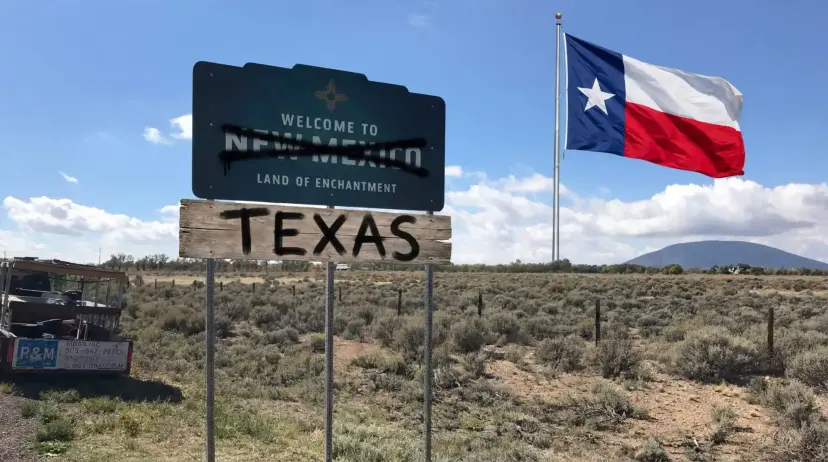

It started with a post on X. Now it is an official committee charge of the Texas House of Representatives.
Speaker Dustin Burrows (R-Lubbock) released his interim charges on March 26, directing House committees to study policy areas ahead of the 90th Legislative Session in January 2027. Buried among directives on property taxes, data centers, and water infrastructure was one item that stood apart: the newly created Governmental Oversight Committee has been ordered to study the “constitutional, statutory, fiscal, and economic implications of adding to Texas one or more contiguous counties of New Mexico.”
The charge goes further than a study. The committee is also directed to recommend “drafts of any requisite legislation or resolutions to initiate the process.”
This is not just a study. Burrows told the committee to come back with draft legislation.
From Social Media to Committee Charge
On January 29, New Mexico state Reps. Randall Pettigrew (R-Lovington) and Jimmy Mason (R-Artesia) filed House Joint Resolution 10 in the New Mexico Legislature. The proposed constitutional amendment would establish a formal process for three or more contiguous counties to secede from New Mexico. Under HJR 10, at least 15 percent of voters in each county would need to sign a petition triggering a special election. Two-thirds of voters would need to approve secession, county commissioners would need to consent, and the move would require a presidential sign-off.
On February 16, Burrows responded on X: “Texas would gladly welcome Lea County back to Texas, where it rightfully belongs.”
As we reported at the time, the amendment faced long odds in the Democratic-controlled New Mexico Legislature. HJR 10 died in committee before New Mexico’s 30-day session ended.

Five weeks later, on March 26, Burrows made it a formal assignment for the Texas House.
The Region in Question
The counties at the center of this conversation (Lea, Eddy, Chaves, and Otero) sit in southeastern New Mexico along the Texas border. They are culturally, economically, and politically aligned with West Texas. Oil rigs dot the landscape. The Permian Basin drives the economy. In the 2024 presidential election, Donald Trump carried Lea County with 80.1 percent of the vote. Santa Fe County, home to New Mexico’s state capital, went for Kamala Harris at 73.3 percent.
Rep. Pettigrew was blunt about the motivation, telling the Albuquerque Journal: “Lea and Eddy counties provide over 50 percent of the general fund revenue and receive little to no recognition for our contribution.”
Former two-term Roswell mayor Dennis Kintigh described the relationship between southeastern New Mexico and Santa Fe as one resembling “a Third World colony.” He noted that everything between the two regions is “almost diametrically opposed” and that there is “no unity” and “no respect for southeastern New Mexico.”
Territory That Was Texas
Most of the news coverage skips the history. This land was Texas.
When Texas declared independence in 1836 and established the Republic, its claimed territory extended west to the Rio Grande and included much of what is now eastern New Mexico. Texas maintained that claim through annexation in 1845. The federal government disputed it. Texas moved to enforce it anyway, organizing Santa Fe County and sending a commissioner to stand up county government in the disputed country. In the summer of 1850 Governor Peter Hansborough Bell called a special session and asked the Legislature for authority to send a military force sufficient to make that authority good. President Millard Fillmore answered by reinforcing the federal garrison and declaring that his troops would resist any Texas militia that entered.
The Compromise of 1850 ended the standoff by buying the claim rather than fighting over it. Texas ceded roughly one-third of its claimed territory, including the land that now makes up portions of New Mexico, Colorado, Kansas, Oklahoma, and Wyoming. In exchange, the federal government paid Texas $10 million to settle its pre-statehood debts. The Pearce Plan, adopted on September 9, 1850, drew the boundaries Texans know today. Texas voters ratified the bargain three to one.
Southeastern New Mexico was on the wrong side of that line. Nearly 176 years later, the people living there are asking to come back.
What It Means for the Self-Determination Debate
The Texas Tribune’s framing of the story was telling. It described the proposal as one that “will likely appeal to pro-secessionists in Texas, some of whom are among Burrows’ conservative skeptics.” Translation: the establishment press sees this as a bone thrown to the Texas Nationalist Movement by a Speaker who needs to manage his right flank.
That framing is wrong.
What is happening in southeastern New Mexico is the same thing happening across the country. In Oregon, 13 counties have voted to explore joining Idaho. In Illinois, 33 counties have signaled support for separation from Chicago-dominated state governance. In Colorado, rural counties have floated the idea multiple times. These are not fringe gestures. They are the predictable result of political systems that concentrate power in urban centers and treat the rest of the state as a revenue source.
The principle at the heart of every one of these movements is self-determination: the right of a people to choose their own form of governance when the existing arrangement no longer serves them.
The principle applies at every level of political organization, from counties to states to nations.
The Texas Nationalist Movement has advocated for the right of Texans to vote on independence for over two decades. The logic is the same whether the question is asked in Lea County, New Mexico, or in Texas as a whole. If three counties in southeastern New Mexico have the right to decide whether Santa Fe governs them, then 30 million Texans have the right to decide whether Washington, D.C. governs them.
Burrows may not see it that way. But the principle he just endorsed does not come with an asterisk.
New Mexico’s Response
New Mexico Democrats, who control both chambers of the Legislature and the Governor’s Office, responded exactly how you would expect.
Governor Michelle Lujan Grisham’s chief spokesperson said New Mexico has “every intention of keeping the great state of New Mexico fully intact” and suggested Texas study New Mexico’s methane emissions record instead. A Senate Democratic spokesperson quipped that annexing counties is a strange priority to put between tax reform and water shortages.
State Rep. Linda Serrato, chair of the New Mexico House Democrats, told the Santa Fe New Mexican that Burrows should “get offline, touch some grass, and get his own House in order.”
That is what politicians always sound like when the people they govern start looking for the door.
What Happens Next
The practical obstacles are real. Changing state boundaries requires consent from both state legislatures involved and approval from the United States Congress. The constitutional bar is high by design. No one expects the Texas-New Mexico border to shift in 2027.
But the border is not the point. The Speaker of the Texas House has directed a committee to draft legislation that would begin the process of absorbing counties from another state. Self-determination, the right of people to choose their own governance, is now a formal subject of study in the Texas Legislature.
Every politician in Austin who has ducked the TEXIT question should take note. If Burrows can put county-level self-determination on the legislative agenda, the question of Texas-level self-determination is not far behind.
The people of southeastern New Mexico want to be part of Texas. The Texas Legislature should take them seriously. And while they are studying the right of New Mexicans to choose their own governance, they might consider extending the same courtesy to Texans.
See more of the Partisan in Google’s Top Stories.Add as a Preferred Source on Google
Read Next
FBI Arrests McKinney Teen in Alleged ISIS-Inspired Plot to Kill Congressman Keith Self
A 17-year-old from McKinney is in federal custody, accused of plotting to kill U.S. Rep. Keith Self in an attack on behalf of the Islamic State, Gov. Greg Abbott said.