
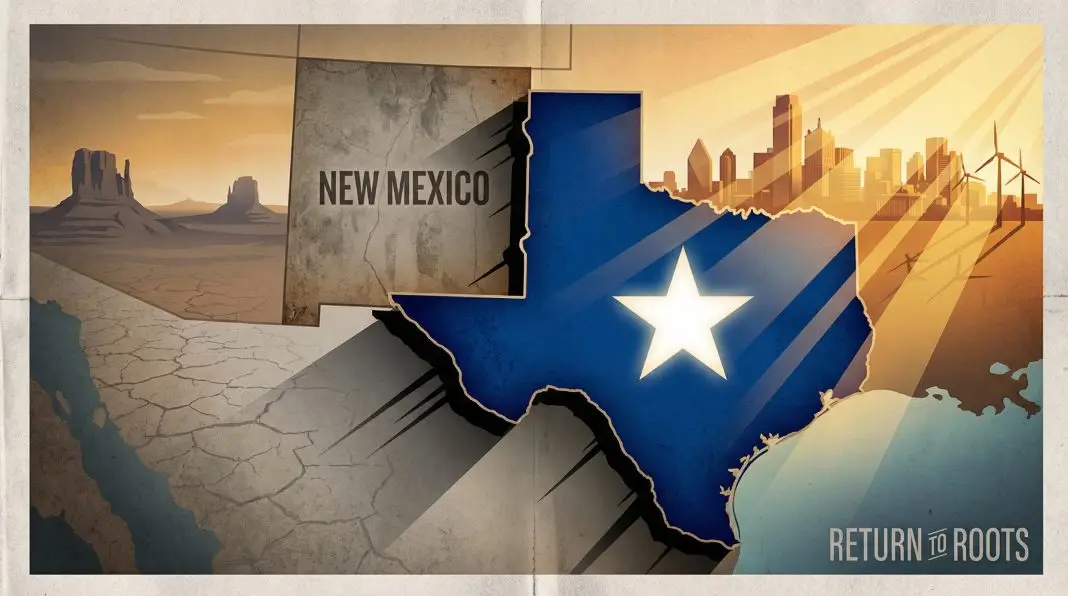


A New Mexico state representative has reintroduced legislation that would allow counties to vote on seceding from the Land of Enchantment. And some residents in the oil-rich southeast corner of the state have a simple message: let us go back to Texas.
State Rep. Randall Pettigrew of Lovington filed House Joint Resolution 10 last week, proposing a constitutional amendment that would let voters in three or more contiguous counties decide whether to leave New Mexico. The resolution needs two-thirds approval from voters in affected counties, plus county commissioner support and a presidential sign-off to take effect.
“We are over 200 miles from Santa Fe,” former Roswell mayor and state representative Dennis Kintigh told the Albuquerque Journal. “Everything is almost diametrically opposed between the two cultures. Santa Fe would never let southeast New Mexico go. They are like a Third World colony to Santa Fe. They want the money that southeast New Mexico generates.”
The southeast New Mexico region of Lea, Eddy, Chaves, and Otero counties bears a striking resemblance to West Texas. Oil rigs dot the landscape. The Permian Basin spans the border. Cattle ranching defines the culture. And until 1850, it was all Texas.
The 1850 Compromise
When Texas ceded claims to roughly 98,300 square miles of territory to the federal government in 1850, land that would become parts of New Mexico, Colorado, Wyoming, Kansas, and Oklahoma, it was not because Texans wanted to give it away. Congress assumed roughly $10 million in Texas debt in exchange. The territory north and west of the present-day Texas-New Mexico border had been part of the Republic of Texas and then the state of Texas for 14 years.
Now, 176 years later, some New Mexico legislators want to give residents the choice to reverse that transfer.
“I think by putting the resolution forward, he highlights an issue that needs to be addressed,” Kintigh said of Pettigrew amendment. “There is a massive cultural disconnect between southeast New Mexico and the state capital.”
The amendment faces long odds in the Democratic-controlled New Mexico Legislature. But the conversation itself signals something larger: the appeal of Texas as an alternative to failed state governance.
Texas as the Answer
This is not the first time this session has seen such legislation. In 2021, then-Sen. Cliff Pirtle introduced a similar resolution, the first such proposal in New Mexico history. And the idea extends beyond New Mexico. Voters in 33 Illinois counties have repeatedly approved measures exploring separation from Chicago. The Greater Idaho movement has pushed for eastern Oregon counties to join the Gem State.
But the New Mexico push carries special weight. These are not just culturally conservative regions looking for a political home. They were literally part of Texas within the living memory of the Republic.
Lea County, the easternmost county in New Mexico, sits directly north of Texas. Hobbs, the county’s largest city, is closer to Midland-Odessa than to Santa Fe. Oil, gas, and ranching drive the region’s entire economy, which operates on Texas time, Texas business relationships, and Texas culture.
Texas offers what New Mexico does not: a state government that resists federal overreach, a business-friendly environment, and an economy that consistently outperforms the rest of the Union. Texans keep more of what they earn. They elect leaders who prioritize the state over Washington.
No wonder New Mexicans in the Permian Basin want in.
The Independence Wave
The New Mexico legislation comes as independence movements across America gain momentum. The Texas Nationalist Movement has grown to over 630,000 supporters. States across the country are having conversations about self-determination that would have been unthinkable a decade ago.
What Pettigrew resolution reveals is this: it is not just Texas wanting to go it alone. It is other states looking at Texas and asking, ‘Why can’t we join them?’
The amendment will likely die in committee. But the idea will not. Until Texans reclaim their sovereignty, the pressure will build. And the region that Texas lost in 1850 will keep asking the question every session.
Support the Texas Nationalist Movement at tnm.me
Comments have moved. The real debate about Texas independence now happens with thousands of Texians in the app.
Get the TEXIAN app
