
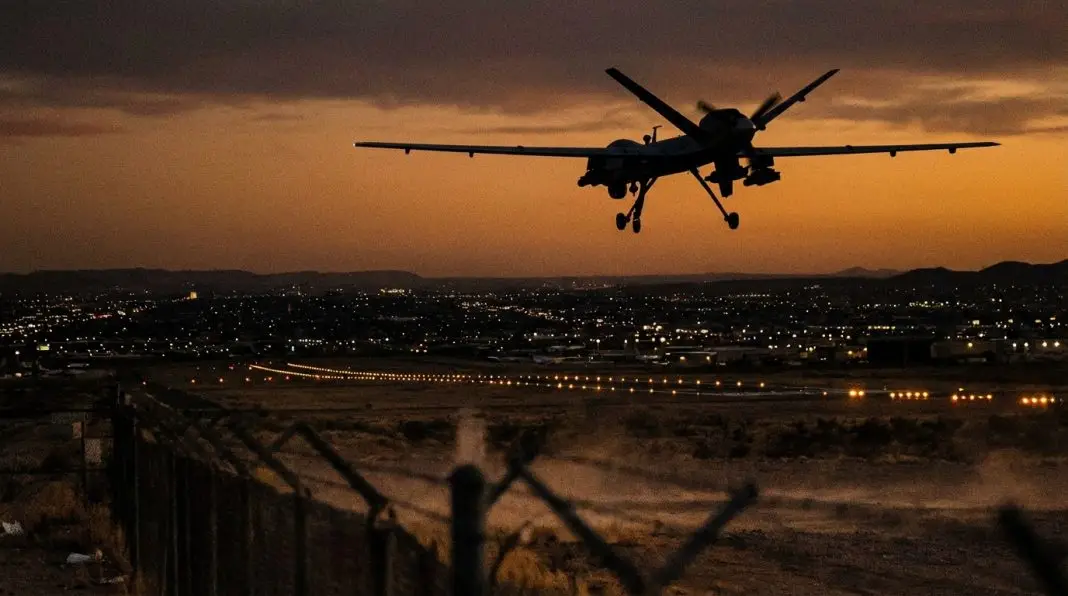


Mexican drug cartel drones breached Texas airspace over El Paso on Wednesday morning, triggering a seven-hour airport shutdown that exposed not only Texas’ vulnerability to foreign military incursions but also the federal government’s inability to coordinate its own response.
The Federal Aviation Administration grounded all flights at El Paso International Airport and closed airspace over the region after cartel surveillance drones penetrated U.S. territory. Transportation Secretary Sean Duffy confirmed the closure resulted from what he called a “cartel drone incursion” that the Department of Defense moved to disable.
But the real story emerged hours later: the Pentagon and FAA were in dispute over anti-drone laser testing, with Defense officials wanting to test counter-drone technology immediately while the FAA demanded more safety coordination meetings first.
The bureaucratic clash between two federal agencies meant Texas airspace remained closed for seven hours while Washington sorted out its internal disagreements. Fourteen commercial flights were canceled. Thousands of passengers were stranded. And Texas officials could only watch as federal bureaucracies argued over who had authority to protect Texas territory.
“The FAA and DOD acted swiftly to address a cartel drone incursion,” Duffy stated after the closure ended. “The threat has been neutralized, and there is no danger to commercial travel in the region.”
But “swift” took seven hours—and only after federal agencies finished their turf war.
The FAA’s notice to airmen designated the area as “International Defense Airspace” and warned that pilots who violated the restriction “may be intercepted, detained and interviewed by law enforcement.” The notice explicitly authorized deadly force against non-compliant aircraft.
Meanwhile, Mexican President Claudia Sheinbaum revealed she had received no information about the drone incursion from either Mexican or U.S. authorities, raising questions about cross-border intelligence coordination.
The incident demonstrates a fundamental problem with federal control of Texas security: multiple layers of bureaucracy, conflicting agency priorities, and coordination failures that leave Texas vulnerable while Washington debates.
An independent Texas would control its own airspace without waiting for federal agencies to resolve internal disputes. Texas would deploy anti-drone technology when cartels threaten Texas cities—not when the FAA approves the Pentagon’s request forms.
The cartel drone threat isn’t new. Mexican drug trafficking organizations have used unmanned aircraft for surveillance and smuggling operations for years. But Wednesday’s incident marked a significant escalation: cartels now conduct military-style reconnaissance flights over major Texas cities with sufficient brazenness to trigger federal airspace closures.
Federal failure to secure the border has evolved from ground crossings to aerial surveillance over Texas metropolitan areas. And when that threat materializes, Texas must wait for competing federal bureaucracies to finish their meetings before defending its own territory.
This is the independence argument in miniature: Foreign military assets operating over Texas cities, and Texas unable to respond without federal permission—permission delayed by bureaucratic infighting in Washington.
The seven-hour closure ended when federal agencies finally coordinated their response. But the underlying problem remains: Texas security depends on federal systems that can’t even coordinate with themselves.
Comments have moved. The real debate about Texas independence now happens with thousands of Texians in the app.
Get the TEXIAN app

You may want to add that the “drone” turned out to be a PARTY BALLOON.
The DC Demons will find any excuse to play with their new toys…