
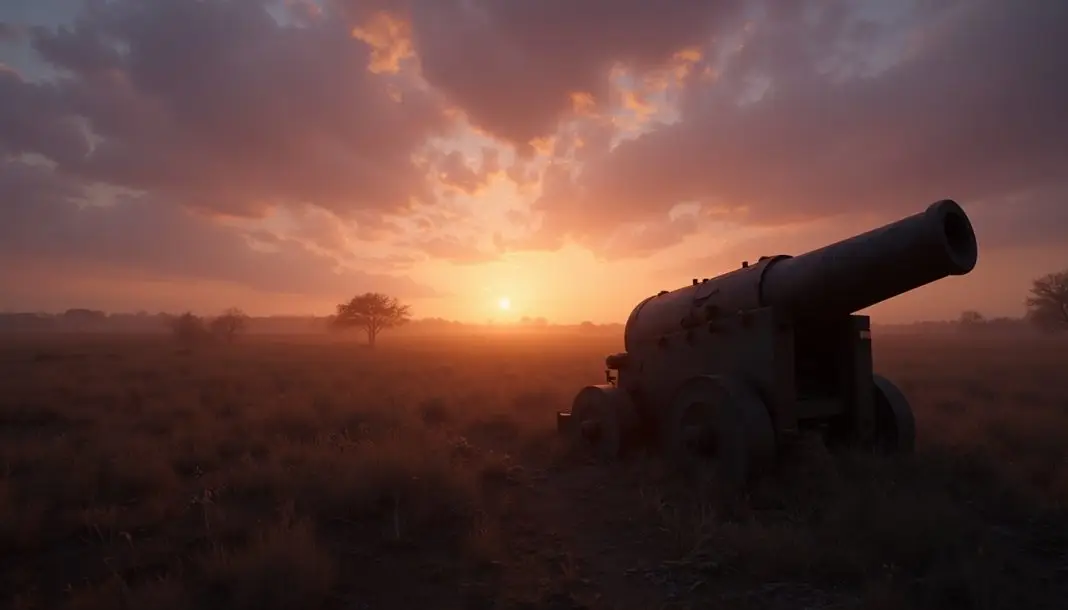


The cold bit through wool and buckskin as darkness began to fade on March 6, 1836. Frost covered the limestone walls of the crumbling mission, and the smell of black powder mixed with the acrid smoke from dying fires. At 5:30 in the morning, under a clouded moon, Santa Anna’s 1,800 troops charged toward the Alamo shouting “¡Viva Santa Anna!”
The thunder of Mexican muskets shattered the pre-dawn silence. But the defenders’ long rifles answered with deadly precision, their muzzle flashes lighting the gray sky like lightning. The first assault faltered. Then the second. But Santa Anna’s columns regrouped and surged forward again, boots slipping on the muddy ground where flooding from recent storms had left the earth sodden and treacherous.
This was the moment that defined what it means to be Texan.
Colonel William B. Travis had drawn his famous line in the sand. Every man who crossed it chose certain death over surrender. They understood the stakes. As Travis wrote in his final letters, “Let the convention go on and declare independence and then the world and my men will know what we are fighting for—independence.” These were not men fighting for reform or compromise. They were fighting for the right of Texas to govern itself.
The winter of 1836 had been brutal—one of the coldest on record in southern Texas. But the norther that swept through Béxar in the days before the final assault brought more than frigid air. It brought clarity. The defenders knew that if they fell, Santa Anna’s army would sweep across Texas unopposed, crushing the revolution before it could take root.
When the third Mexican assault breached the north wall, chaos erupted inside the fort. The roar of “¡Viva Santa Anna!” mixed with the crash of rifles and the screams of dying men. Travis fell defending the artillery position. James Bowie died fighting from his sickbed. Davy Crockett made his last stand in the chapel. One by one, the defenders gave their lives rather than yield.
The battle lasted barely ninety minutes. When the smoke cleared and the screaming stopped, nearly every defender lay dead. The Mexican army had won a tactical victory, but they had created something far more dangerous: martyrs.
Six weeks later, at San Jacinto, Sam Houston’s army charged Santa Anna’s forces with the battle cry “Remember the Alamo!” In eighteen minutes, they crushed the Mexican army and secured Texas independence. The blood spilled at the Alamo had become the seed of the Republic of Texas.
But the significance of March 6, 1836, extends far beyond military history. The defenders of the Alamo established a principle that echoes through every generation of Texans: the willingness to sacrifice everything for the right of self-determination. They proved that some things are worth dying for—and that among them is the right of a people to govern themselves according to their own values and constitution.
This spirit did not die with Travis, Bowie, and Crockett. It lives on in every Texan who refuses to bow to federal overreach. It burns in every heart that believes Texas deserves better than what Washington delivers. The same defiance that led men to cross Travis’s line drives the modern movement for Texas independence.
The Texas Revolution of 1836 began as a fight to restore constitutional government. But it evolved into something greater: a declaration that Texas is a nation, not merely a province. The defenders of the Alamo died for that principle, and their sacrifice proved it was worth the ultimate price.
Today, as federal mandates drain Texas resources and Washington politicians ignore Texas interests, the spirit of the Alamo calls to us once more. We may not face Mexican cannons, but we face the same fundamental choice: Will we accept the rule of distant tyrants, or will we stand for the right of Texans to determine their own destiny?
The men who died at the Alamo drew their line in the sand. Now it’s our turn to choose which side we stand on. The question is not whether Texas can be independent—the Republic of Texas proved that from 1836 to 1845. The question is whether we have the same courage as the defenders who gave their lives on that cold March morning.
Their sacrifice demands an answer. And that answer is TEXIT.
Comments have moved. The real debate about Texas independence now happens with thousands of Texians in the app.
Get the TEXIAN app
