
From the archive. Published October 4, 2026.
Two Canadian Provinces Approach Independence Votes Under Different Legal Rules
Quebec votes October 5 and Alberta October 19. One route runs through a party's promise, the other through a government-written question, and Ottawa's Clarity Act treats them differently.

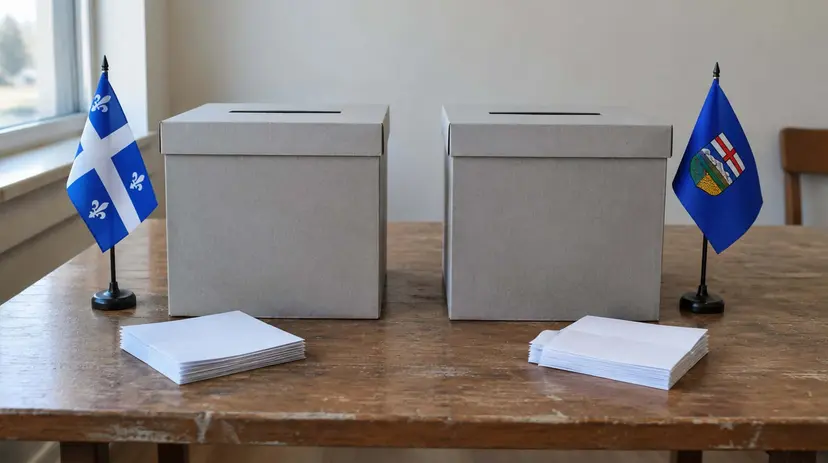

Two Canadian provinces go to the polls this month on questions that bear on independence, and they are doing it by different legal routes. Quebec elects a government on October 5, and the party leading the polls has promised a referendum on sovereignty in its first term. Alberta votes on October 19 on a question its own government wrote, asking whether to start the process toward a binding referendum on separation.
Alberta’s route runs through its government. The province called the vote under its Referendum Act, and question 10 asks voters to choose between remaining a province of Canada and having the government “commence the legal process required under the Canadian Constitution to hold a binding provincial referendum on whether or not Alberta should separate from Canada.” The order that put the question on the ballot directs that the result is not binding. Premier Danielle Smith has called the vote “testing the waters.” Her press secretary said in September that if Albertans give that direction, the government “would begin the legal process under the constitution to hold the binding referendum as soon as possible.”
Quebec’s vote would come out of an election, and no question exists yet. Parti Québécois leader Paul St-Pierre Plamondon has said a PQ government would hold its referendum after January 20, 2029, and has budgeted $110 million to hold it in 2029 or 2030. Under Quebec’s Referendum Act, the text of a question goes to voters only after the National Assembly adopts it on a motion from the premier, and debate on that motion is capped at 35 hours. A separate Quebec law passed in 2000 fixes the winning threshold as “50% of the valid votes cast plus one.”
Ottawa wrote its own statute the same year. The Clarity Act requires the House of Commons, within 30 days after a province releases a question on leaving Canada, to decide by resolution whether the question is clear. Under the act, a question that “merely focuses on a mandate to negotiate” cannot produce a clear result. After a vote, the House decides whether a “clear majority” has spoken, weighing the size of the majority and the share of eligible voters who turned out. If the House finds the question unclear, the federal government may not negotiate the terms on which the province would leave.
Alberta’s question has already been kept out of that process. In May, Prime Minister Mark Carney told the House of Commons the act does not apply to Alberta’s question, which he described as “a question about a question.” In an August recording, Smith described a later binding question going to the House of Commons for approval after roughly two and a half months of consultation.
A PQ question would face the House from the start. The Bloc Québécois, which sits in the House, rejects that role. In May, Bloc MP Christine Normandin said the decision in Alberta is “only up to them,” adding, “The same way it will be up to Quebecers to decide on their future.” Her colleague Rhéal Fortin called for the Clarity Act to be repealed.
The two provinces write their own questions. Ottawa’s law gives the House of Commons the final word on whether the question and the answer count.
See more of the Partisan in Google’s Top Stories.Add as a Preferred Source on Google